What is Departmentalization? Learn the Different Types, Advantages, and Practical Applications in Business
Table of contents
- What is departmentalization?
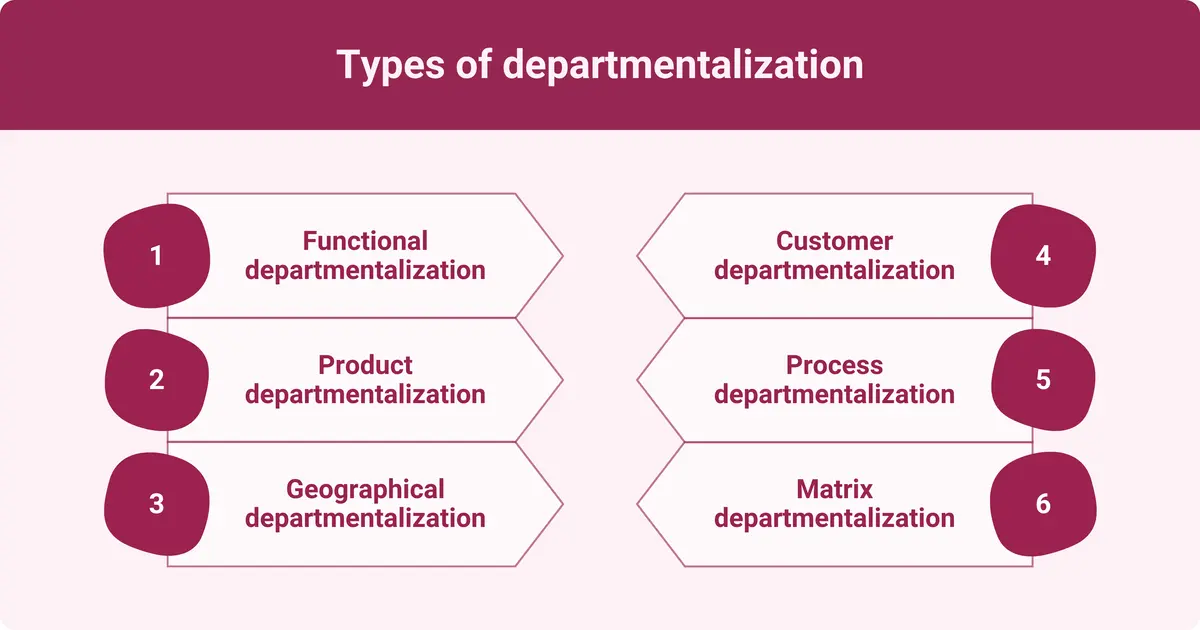
- Types of departmentalization
- Departmentalization examples from Fortune 500 companies
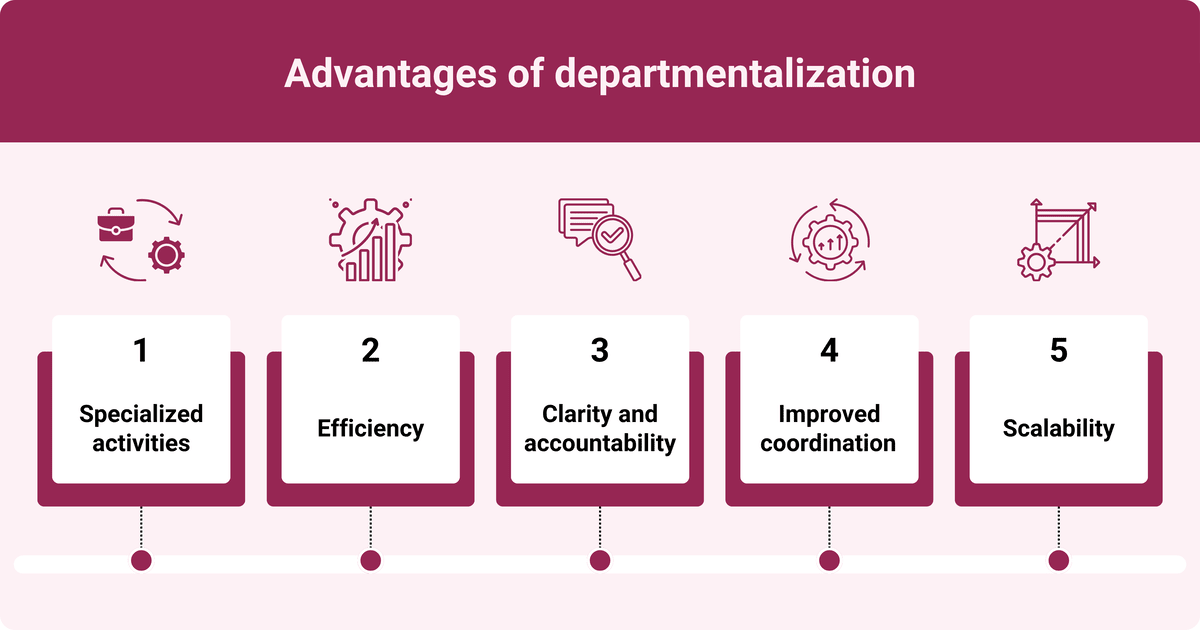
- What are the advantages of departmentalization?
- What are the disadvantages of departmentalization?
- When should you use departmentalization?
- Departmentalization vs delegation: understanding the difference
- FAQ
- Conclusion
Organizational structure is critical for any business hoping to thrive and grow. Without a strong structure, employees don't know their responsibilities, managers can't offer clear direction, and operations grind to a halt.
For many companies, departmentalization — separating employees into groups with specialized knowledge and skills — is the key to getting things done and making the company's vision a reality. Your organization can expand and diversify its operations without sacrificing oversight and authority.
At the same time, it can enhance efficiency, improve communication, and increase productivity by grouping activities related to specific functions or products.
With so many upsides, departmentalizing can sound like a dream come true, but the reality is more complicated.
Before you can start establishing departmental structures, you first have to decide on your approach, and apply strategic leadership practices to ensure the structure supports long-term goals. Will you create departments based on functional, geographic, or product-based criteria? Each option has unique pros and cons, so selecting the right approach can be tricky.
In this article, we'll dig into the details of departmentalization, looking at types, examples, benefits, and challenges. We'll also share implementation strategies you can use when organizing departments for your company.
What is departmentalization?
Departmentalization is the process of grouping organizational activities and dividing an organization into distinct units based on functions, products, geography, customers, or processes.
In simple terms, departmentalization means dividing a company into departments like HR, Marketing, and Sales so that people doing similar work are grouped together.
Each department focuses on specific goals and outcomes related to the employees' skills and background. In some situations, several departments collaborate on large-scale assignments.
The practice of departmentalization is crucial for many organizations because it increases efficiency and allows employees to specialize in their areas of expertise. In addition, it simplifies management practices, particularly for large or enterprise-level companies, by allowing for closer supervision and better employee support.
Types of departmentalization
To implement departmentalization in your organization, begin by categorizing employees. You can break them into groups in a variety of ways based on your business structure, size, and fit assessment.
Functional departmentalization
A functional organizational structure is one of the most popular options because it's straightforward and versatile. In this type of departmentalization, businesses split employees into groups based on their functions, or the type or subject of work they do.
Functional areas such as finance, production, human resources (HR), and marketing departments require different sets of skills and education. Establishing departments focused on these subjects allows professionals with similar training and expertise to closely collaborate and share their knowledge.
For example, a manufacturing company has a separate sales department, research and development wing, customer service team, and production department. Each group of employees focuses on critical aspects and functional areas of the operation to improve the efficiency, accuracy, and quality of their work.
Product departmentalization
Product departmentalization is common among companies designing, producing, or selling multiple types of products. They divide employees into groups and assign them to work exclusively on certain items or groups of items. This allows staff to develop in-depth knowledge of those products, shortening the development lifecycle.
Product departmentalization is especially useful for large businesses with extensive product lines. Expecting employees to fully understand every product is unrealistic and typically inefficient, resulting in poor quality and slowed processes.
Imagine you run a company responsible for producing home goods. Rather than expecting all your employees to have involvement in your entire product catalog, you create separate departments for home textiles, bath and kitchenware, furniture, and home decor.
An employee in the home textiles department will know everything there is to know about area rugs, while a furniture department employee will be an expert in sofas and love seats.
Geographical departmentalization
If you have a business with multiple locations, geographic departmentalization can make your operations more manageable. As the name suggests, this involves splitting employees into groups by geographical area. This might mean looking at the location where they work or where their clients live.
Organizing departments by geography allows your employees to better serve their specific customers. They can tailor their services, products, or marketing to the local clients' culture, needs, and preferences.
A customer service company might segment departments based on which state the employees serve. For example, some workers might answer calls from customers in California, while a different department handles help requests from New York. On a broader scale, the company might create departments for countries or regions, such as Europe, North America, and the Asia Pacific.
Customer departmentalization
Organizations serving different kinds of clients, such as corporate and consumer, sometimes departmentalize by customer type. This approach allows each team to adapt its services to specific needs, build stronger relationships with customers, and respond more quickly to questions and requests for support.
For instance, a technology manufacturing company might sell its products to three major electronics stores and have a different department for each one. In addition, they may have a separate department for individual consumers. As another example, a financial services firm might have departments for retail, small business, and corporate clients.
Process departmentalization
Process departmentalization segments employees based on where they work in the production process. The company looks at the sequence of activities involved in creating a service or product and assigns employees according to their skills and training.
This is an especially common organizing option for manufacturing and production companies because it allows employees to specialize in a particular area and maintain a high level of quality.
For an auto manufacturing business, this might break down into one department ordering raw materials, another stamping the parts, a third handling assembly, and a team for painting and finishing. The company could also have a final department for transporting the vehicles to sales lots.
Matrix departmentalization
An organization may use more than one type of departmentalization, such as functional and product. Combining multiple forms of departments may complicate management processes, but it can also enhance collaboration, communication, and resource allocation.
In an organization using matrix departmentalization, employees typically report to managers in both departments. In many cases, both supervisors have equal authority but different responsibilities.
For instance, the functional manager might oversee day-to-day operations, while the product manager ensures employees across the two departments are working toward a shared vision, sticking to the budget, and staying on schedule.
Companies also often combine geographic departmentalization with another form. For instance, a beverage company might have product departments for non-alcoholic, alcoholic, and juice drinks. They could also have geographic departments for the United States, Canada, and the United Kingdom.
Departmentalization examples from Fortune 500 companies
Organizational structure is a top priority for most of the world's biggest companies because they recognize its wide-ranging effects. They know departmentalization is the key to achieving organizational effectivenessOpens in a new tab, while also saving money, increasing productivity, and boosting sales.
For that reason, Fortune 500 companies take great care when establishing departments and assigning employees — and their plans have paid off. These are some of the most successful departmentalization examples:
- Google: Google uses a matrix structure, with employees reporting to both functional and project managers. They have teams for marketing, research and development, sales, human resources, and finance, and also separate into business units for Google Search, YouTube, Android, and Cloud services.
- Apple: The departments at Apple center around functions, including design, hardware engineering, software, and machine learning and artificial intelligence (AI). They also use product-based departmentalization for their iPad, Mac, and iPhone lines.
- Amazon: Amazon's hybrid departmentalization combines functional and geographic structures. They have two geographical divisions — North America and International — and functional departments such as Amazon Web Services, devices, and digital entertainment.
- Starbucks: Starbucks uses geographic departmentalization, breaking employees into groups for North America, International, and Channel development. Their matrix structure also includes functional divisions, such as marketing, supply chain, and product development.
The common thread across all these examples is their use of multiple kinds of departmentalization. The right combination of structures allows them to adjust their products and services to different customer bases.
What are the advantages of departmentalization?
Departmentalization is a widespread practice across nearly every industry. For the past century, it has helped businesses enhance their operations and elevate employee performance thanks to its many benefits.
Specialized activities
One of the most significant advantages of departmentalization is allowing employees to focus on specific tasks. Grouping similar functions into departments encourages staff to upskill in their areas of expertise.
Over time, this results in higher performance and quality for the organization. Instead of trying to master an overwhelming number of duties, your employees can become proficient in a narrower field. You can also offer more effective training programs in areas specific to those employees' tasks.
Efficiency
By breaking operations into departments, you are allowing company leadership to allocate resources, including staff, more efficiently. Each department can focus on its specific tasks and processes, and you put employee talent to its best possible use. Placing employees in the right department helps them maximize their productivity and work to their full potential.
This heightened efficiency also extends to departmental managers. According to the study "Effect of Organizational Structure on Managerial Decision Quality at Flour Mill of Nigeria, LagosOpens in a new tab" from the International Journal of Public Administration and Development Studies, departmentalization has a significant impact on managerial decision-making.
It enables leaders to make faster, more informed, and more effective decisions. Not only do department managers have a deeper understanding of their area, but they don't have to send decisions through as many levels of the hierarchy, allowing them to act more quickly.
Clarity and accountability
Clearly defined departments help your organization establish roles and responsibilities. Employees have certain areas of expertise, and the company and their departmental managers have clear expectations for their performance. This eliminates confusion and cuts down on errors.
Each department has a set of defined goals, simplifying performance measurement so you can give more helpful feedback.
Departmentalization also establishes a chain of command, so employees know who they report to and who will evaluate their work. While the individual employee is accountable for their specific tasks, their manager is responsible for the department's overall performance.
This gives everyone on the team a sense of ownership over their work, providing natural motivation and allowing organizational leadership to assign credit to the appropriate employees when projects are successful.
Improved coordination
When you group employees in departments, collaboration and coordination become easier for everyone (that coordination still depends on managers’ core people management skills, especially when priorities compete across teams).
Teams are working on similar projects or functions, so they can share knowledge about their tasks and support one another's successes. They also know which colleagues to reach out to when working on a project, and they become familiar with their managers.
From a manager's standpoint, departmentalization streamlines supervisory tasks. For example, with employees divided into a set team, the manager can get a closer look at each individual's strengths and needs. As a result, managers can more effectively delegate tasks, give instructions, and provide feedback.
Scalability
If you're hoping to expand your organization, departmentalization provides the framework you'll need to grow. It creates a scalable structure capable of accommodating changes in business size.
As you bring on additional employees, you can create more or new departments and management layers. With your existing departments already in place, you have the capacity to create new products or enter new markets without causing havoc in your existing operations.
A departmental organization also helps your management staff tackle the inevitable challenges you'll encounter as your company grows.
A study from the International Journal of Environmental Planning and Management shows departmentalization has a positive effect on management performance, making departmental leaders better prepared to adapt and adjust their strategies for different customer segments.
What are the disadvantages of departmentalization?
Although departmentalization has significant upsides for most organizations, it also comes with some obstacles. Understanding the challenges will help you minimize or eliminate them before they become a drain on your business.
Duplication of efforts
One of the greatest risks of splitting into separate departments is inadvertently creating redundancies.
Some organizations duplicate similar processes or functions across departments, leading to inefficiencies and increased costs.
For example, in product departmentalization, each product department may have its own marketing team. While each team is working on marketing for their specific product line, your company may be wasting resources repeating efforts, ultimately increasing the overall cost of your marketing.
Inconsistent practices
Departments can sometimes become disconnected, causing employees to feel isolated. When teams lack communication and don't cooperate outside their bubbles, it becomes more difficult to maintain quality and expectations throughout your organization. Inconsistencies in practices, policies, and procedures make it harder to form a unified corporate culture and brand identity.
High administrative costs
Departmentalization can save significant time, energy, and resources when done well, but it can also raise costs. Redundant staffing, such as employing multiple financial experts for every department, can significantly increase your overall expenses.
The same is often true of management staffing. Rather than employing a few general managers, your company has to hire individual managers for every department, and each of them may require a separate office space. You may also need to employ more assistant managers and support staff, dramatically increasing your costs.
Some companies also face higher coordination expenses, particularly if there's conflict between departments. Disagreements among managers can slow down decision-making processes, making your operations less efficient. Costs are more likely to rise if you use matrix departmentalization, where administration is especially complex.
Limited cross-functional exposure
Another risk of departmentalization is the creation of silos, which can limit information and idea sharing. Employees primarily work with colleagues from the same background and foundational knowledge. As a result, information about key processes and strategies stays within the department.
Some businesses experience a lack of communication and collaboration across departments, particularly when they don't implement formal measures to ensure employees come out of their silos and interact with others. When this happens, employees miss out on opportunities to share their diverse perspectives, which in turn can restrict innovation in the workplace.
For example, the sales team of a global retail chain store might have insights into a recent product line and customer preferences, which could help the research and development department improve future products. However, if the two departments rarely come together, they're unlikely to share those ideas, costing the company money and creative opportunities.
Holding interdepartmental meetings or using project management software are simple ways to make sure communication occurs across departmental lines.
Departmental isolation can also have a negative effect on employees. Although they can become highly specialized in a departmentalized environment, they may miss out on opportunities to participate in cross-functional projects, which could limit their professional development.
In some cases, this means they'll have fewer chances to branch into other areas of the company, potentially hindering their growth or career advancement.
When should you use departmentalization?
Any organization, including small businesses, can separate employees into groups, but structuring your company this way isn't always necessary. However, departmentalization is essential for most large companies, where properly managing hundreds or thousands of employees can be challenging, or even feel impossible, without some division.
Creating departments allows you to maintain authority and accountability, even with very large workforces.
Smaller organizations planning or in the middle of expansion can also benefit from departmentalization. Using strategic planning models helps growing organizations design departments that can scale without constant rework. Oversight becomes more complex as your business scales, and addressing those issues upfront by segmenting employees makes the transition smoother.
With effective departments, business leadership can focus on growth strategies while departmental managers take care of daily operations and employee supervision.
Finally, departmentalization is a vital step for improving your operational efficiency. It allows you to optimize task delegation, pinpoint problems, and address performance issues more effectively.
Departmental managers also have more opportunities to mentor employees, help them address challenges, and navigate the workplace.
Departmentalization vs delegation: understanding the difference
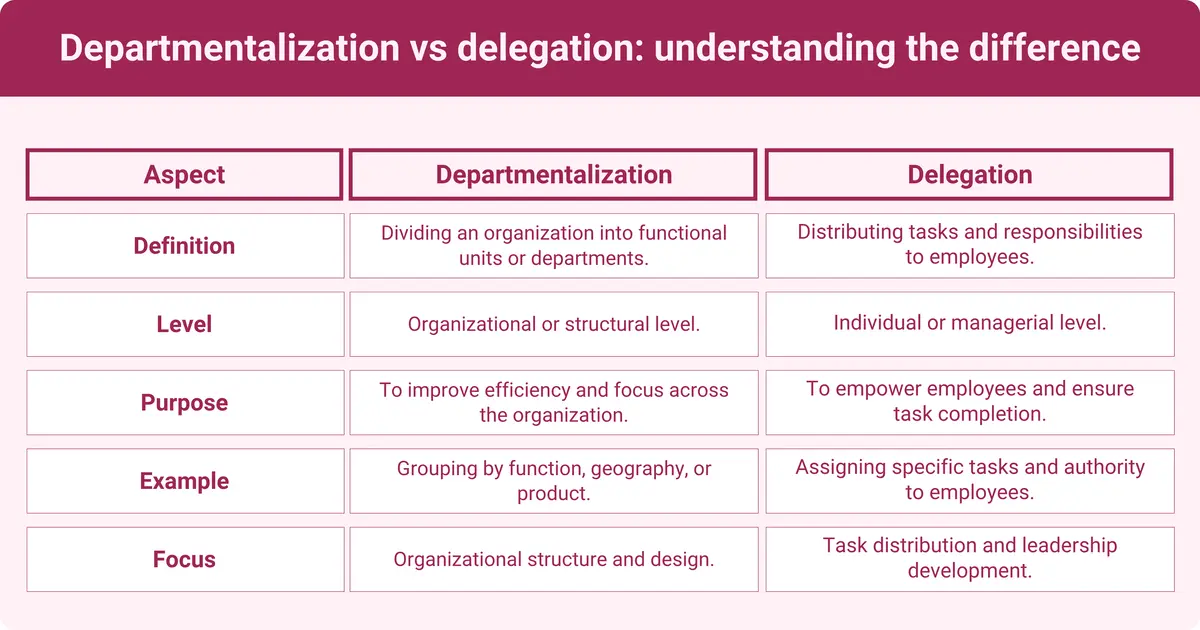
Organizations sometimes confuse departmentalization with delegation. While they're both crucial aspects of business management, they're separate processes with different purposes.
Departmentalization refers to dividing the company into groups or units to achieve greater efficiency. Delegation, on the other hand, is the distribution of work tasks among employees.
When supervisors delegate duties to specific employees, they empower and grant them authority. This occurs at the individual or managerial level, whereas departmentalization happens at the organizational or structural level.
FAQ
How does departmentalization affect communication?
Departmentalization shapes who talks to whom and how fast information moves. Clear departments can streamline updates within a group, but they can also create silos that slow cross-team decisions. Strong lateral links — shared goals, regular cross-functional meetings, and collaboration tools — help keep communication consistent and customer-focused.
How do you choose the right departmentalization structure for your company?
Start with your strategy and how work flows. If speed and specialization matter most, functional departments may fit. If you serve distinct markets or products, divisional or product structures can improve focus. For complex, fast-changing work, consider matrix or hybrid models. Test options against costs, clarity, and accountability.
What is the relationship between span of control and departmentalization?
Span of control is how many direct reports a manager oversees; departmentalization determines how those roles are grouped. Narrow spans often pair with more layers and tighter supervision, while wider spans push decisions downward and require clearer processes. The right combination balances oversight, workload, and employees’ ability to work independently.
How is departmentalization different from specialization?
Specialization is dividing work into specific tasks or roles (for example, payroll, recruiting, or sales). Departmentalization is how you cluster those specialized roles into units, such as an HR department or a customer success team. Specialization increases expertise; departmentalization organizes expertise so work can be coordinated and managed.
What are hybrid departmentalization models?
Hybrid departmentalization models blend two or more approaches to match real-world complexity. A common example is a functional base (marketing, finance, IT) paired with product or regional teams that own outcomes. Hybrids can improve flexibility and customer alignment, but they need clear decision rights to avoid confusion and duplication.
How do you measure the success of a departmentalization strategy?
Measure success by linking structure to outcomes. Track operational metrics like cycle time, handoffs, error rates, and costs, plus people metrics like engagement, retention, and manager workload. Qualitatively, ask whether decisions are faster, responsibilities are clearer, and collaboration feels easier. Review quarterly and adjust as the business evolves.
Why is departmentalization important?
Departmentalization matters because it turns strategy into an operating system. It clarifies who owns what, reduces duplicated effort, and helps teams build deep expertise. When designed well, it improves coordination, speed, and accountability across the organization. When designed poorly, it can create silos—so periodic review is essential.
Conclusion
Departmentalization is an essential process for many businesses, allowing them to operate more efficiently, enhance employee performance, and optimize their offerings for different kinds of customers. Companies can establish departments in a variety of ways, from grouping employees based on their specializations to setting up divisions for different geographic regions.
No matter what departmental structure you decide to use in your business, remember your organization still has to function as a whole. Promoting skill development and specialization is crucial, but teams should also have the chance to work together across departments.
The combination of cross-functional collaboration and clearly defined departments is a winning recipe for any growing business.
About the author
Ryan Stoltz
Ryan is a search marketing manager and content strategist at Workhuman where he writes on the next evolution of the workplace. Outside of the workplace, he's a diehard 49ers fan, comedy junkie, and has trouble avoiding sweets on a nightly basis.