Organizational Design: Principles, Models, and Implementation Guide for HR Leaders
Table of contents
- What is organizational design? Definition and core principles
- Common organizational design models and frameworks
- Key factors that shape organizational design decisions
- Types of organizational structures: matrix, functional, divisional, and more
- Organizational design vs. organizational restructuring: key differences
- How to implement organizational design: a step-by-step process
- Common organizational design challenges and mistakes to avoid
- Organizational design for lifecycle stages and remote/hybrid
- FAQs
Organizational design is the strategic process of aligning your structure, processes, people, and systems with organizational goals. When done well, it accelerates decision-making, reduces friction, and positions your organization to scale without constant reorganization. When done poorly, it creates confusion, slows execution, and drains engagement.
For human resources (HR) leaders and executives, understanding how to design or redesign an organization is critical to enabling agility, improving performance, and supporting sustainable growth. Yet many organizations approach design reactively, restructuring in response to crises rather than proactively shaping structures to support strategy.
This guide covers foundational principles, common models like Galbraith's Star Model and McKinsey's 7S Framework, and a step-by-step implementation process. You'll learn how to diagnose your current state, choose the right structural model for your context, and measure the impact of design decisions.
Whether you're navigating hybrid work or leading transformation at an enterprise, this resource will help you make informed structural choices that stick.
What is organizational design? Definition and core principles
Organizational design is a core management theory that focuses on configuring structures, roles, processes, and systems to achieve strategic goals.
This differs from ad-hoc restructuring by being more proactive, holistic, and aligned with business strategy. Effective design balances efficiency, such as cost and speed, with flexibility and responsiveness to create a competitive advantage and conditions for employees to perform at their best.
Key principles that guide effective design
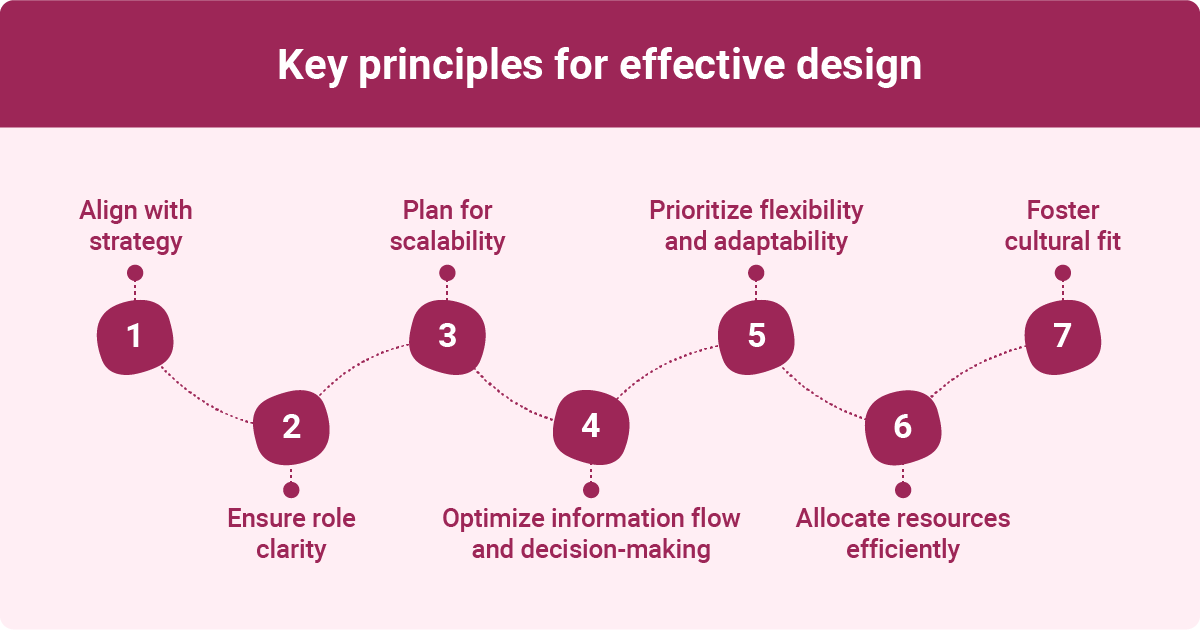
Constraints and priorities guide leaders as they make organizational design decisions and evaluate trade-offs between structural options. Core principles of organizational design and structure include:
- Strategy alignment: Structure and other design choices should follow the strategy, not the other way around.
- Role clarity: Minimize overlap and ambiguity in decision rights, accountabilities, and interfaces between teams.
- Scalability: Design for growth so the organization can add people, products, or markets without constant reorganization.
- Information flow and decision-making: Ensure the right information reaches the right people at the right time with clear decision paths.
- Flexibility and adaptability: Build the capacity to reconfigure teams, workflows, and roles while adapting to change in response to market or internal shifts using flexible working policies.
- Resource allocation: Align people, budgets, and technologies with strategic priorities rather than historical structures or polities.
- Cultural fit: Ensure your chosen design is compatible with – or intentionally shapes – the organization’s values and behaviors.
Why organizational design is important for business performance
Key benefits of effective organizational design include:
- Accelerating decision-making: A well-structured design clarifies authority, reduces bottlenecks, and shortens escalation paths. According to findings in the article ‘AI-based decision making: combining strategies to improve operational performanceOpens in a new tab’ in the International Journal of Production Research, organizational structure plays a significant role in decision-making, strategization, and strategy mediation.
- Empowering employees: Strong designs give employees clear authority, ownership, and autonomy within well-defined structures and processes. For instance, the study, ‘Hybrid Work Model: An Approach to Work–Life Flexibility in a Changing Environment’, found that giving hybrid employees autonomy over their schedules boosts work-life balance and minimizes operational costs.
- Improving employee engagement and psychological safety: A well-defined organizational structure establishes clear roles, career paths, and fair workloads.
- Supporting strategic pivots: Organizational design lets you embed adaptability into your structure, such as by entering new markets or adopting new technologies.
- Improving overall execution: A tailored organizational design reduces operational friction, redundant effort, and conflicting priorities across teams.
- Supporting collaboration and onboarding: Organizational design provides a blueprint for how work gets done for streamlined teamwork and training. Organizational structure influences new hires' onboarding and learning experiences just as much as the learner's individual behavior.
6 key elements of organizational design
Leaders should design and implement the right organizational structure to maximize functionality and streamline operations. The best designs focus on the following core components:
1. Strategy: This component clarifies the organization's objectives and the capabilities it must build. Your strategy serves as the anchor for all other elements.
2. Structure: Your structure defines reporting lines, departments, spans of control, and how work is grouped, such as by function, product, or geography.
3. Roles and people: When leaders assign roles to employees, they specify responsibilities, decision rights, skills requirements, and how to deploy talent across the structure.
4. Processes and workflows: Fixed processes establish how work flows across teams, including during handoffs, approvals, and cross-functional collaboration.
5. Information, systems, and resource allocation: The right tools and systems ensure data, tools, and budgets are available where needed to carry out work effectively.
6. Rewards and metrics: Rewards, recognition, and performance tracking systems let you align incentives and performance metrics with desired behaviors and outcomes to reinforce the design over time.
Common organizational design models and frameworks
There's no single "best" structure or framework that applies universally to every business. Instead, you can choose from multiple established organizational design models and frameworks, such as functional, divisional, matrix, and flat structures. As a business leader, your best options hinge on your company's size, industry, growth stage, operating model, strategic priorities, and other similar factors.
Some of the common organizational design models and frameworks include:
Galbraith's Star Model: a holistic design framework
Jay Galbraith's 'Star ModelOpens in a new tab' creates a reliable decision-making foundation by highlighting strengths, gaps, and misalignments in existing structures. This conceptual framework helps leaders think holistically about alignment across strategy, structure, people, processes, and culture.
Galbraith's Star Model prioritizes coherence, recognizing that misalignment in one area can negatively impact others. This model is particularly useful for diagnosing misalignment in your organization's current design.
For example, tracking productivity with the Star Model could highlight when employee rewards and recognition programs are and aren't reinforcing desired behaviors. These insights can help you refine the behaviors and achievements you recognize and the level of feedback you give to struggling employees.
McKinsey 7S Framework: understanding organizational interdependencies
As demonstrated by ‘Evaluating Organizational Performance of Public Hospitals using the McKinsey 7-S FrameworkOpens in a new tab’, which is a study published in BMC Health Services Research, the McKinsey 7S Framework distinguishes between hard and soft elements to provide comprehensive insight into the factors impacting workflow. This framework highlights the cultural and leadership factors that are often overlooked in purely structural redesign efforts.
These insights are particularly useful for change management, such as when adopting new workflows, software, or structures. The framework helps you consider all seven core elements that affect your organizational design by pinpointing specific setbacks and highlighting how different variables are interconnected.
The McKinsey 7S Framework's "hard elements" include:
- Strategy
- Structure
- Systems
The framework's "soft elements" include:
- Shared Values
- Skills
- Style
- Staff
Traditional vs. modern organizational design approaches
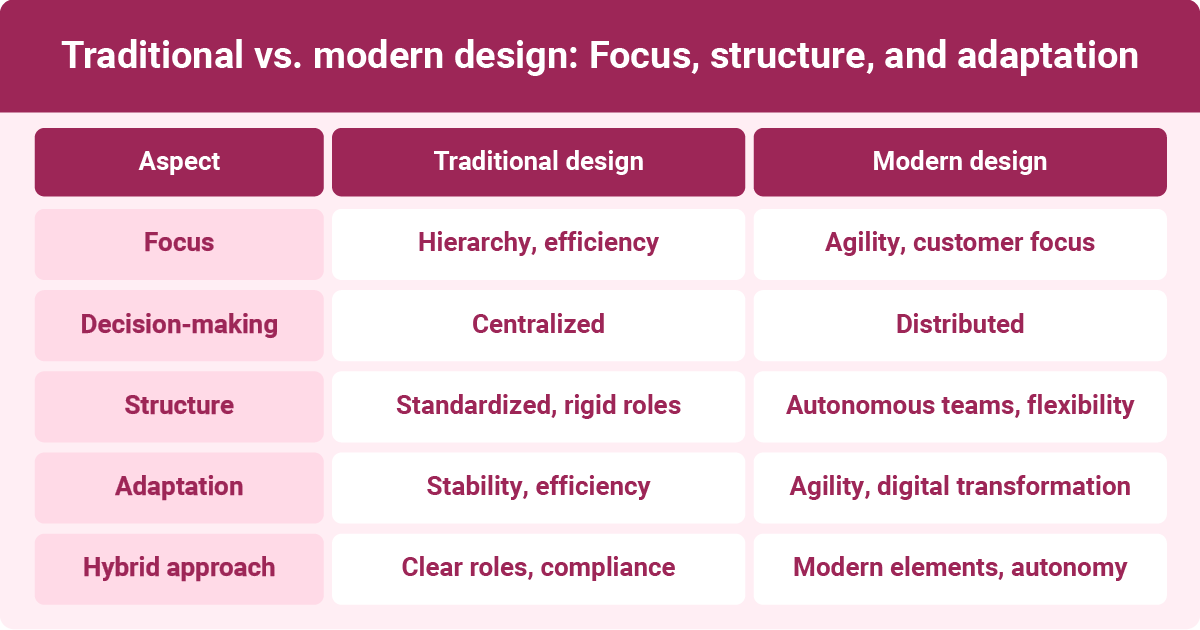
Traditional organization designs emphasize hierarchy, centralized control, standardization, and efficiency. Examples include Taylorism, hierarchical structures, bureaucratic, matrix, and functional models.
On the other hand, modern design prioritizes agility, distributed decision-making, cross-functional collaboration, and customer centricity. More businesses are shifting to modern approaches to prioritize adapting to change amidst market volatility, digital transformation, and the rise of knowledge work.
Some organizations have also adopted hybrid approaches. They retain traditional structural elements, such as clear accountability and compliance, while adding autonomous teams, networks, and other modern elements. Your best approach will ultimately depend on your industry stability, regulatory environment, risk tolerance, and workforce capabilities.
Real-world examples: how leading companies design their organizations
The case study, ‘Organizational Readiness for Change and Design using Galbraith's STAR Model: A Case Study of Digitalization at a Small and Medium EnterpriseOpens in a new tab (PDF)’, published in the International Journal of Current Science Research and Review, focused on an apparel company, CV XYZ, that used Galbraith's Star Model to identify factors contributing to sales stagnation.
The intensive analysis identified technical competencies, digital literacy, and structural misalignment as the core variables that are impairing market growth. These insights created an easy roadmap for the organization to expand its market potential.
Meanwhile, a case study, ‘Proposed Organizational Effectiveness Improvement Using 7s McKinsey And 5 Why Root Cause AnalysisOpens in a new tab (PDF)’, by Mochamad Rizki Firdaus, followed Growtheseed, an independent book printing and publishing business. This organization used the McKinsey 7S framework to address turnover and other issues blocking the business from achieving its goals.
The framework gathered quantitative and qualitative data from company data, interviews, and questionnaires to identify the five root causes of the business's setbacks. These insights enabled Growtheseed to introduce tailored design and new strategies for change management to support its future growth.
Key factors that shape organizational design decisions
Understanding the factors that influence organizational design lets you compare each framework's strengths with your business's unique needs:
1. Strategy: Your greater business strategy and goals should be the primary drivers of your design choices. An effective strategy requires you to consider your organization's technology, culture, external environment, and organizational size and lifecycle. It’s important to pay attention to signals outside your organization, too – they can help you anticipate what’s coming and design for future needs, not just today’s priorities.
2. External environment and market conditions: Functional, efficiency-focused structures benefit organizations in stable industries and market conditions. Meanwhile, divisional and networked structures can better suit volatile markets that require flexibility.
3. Technology: Relying less on technology can support more employee independence. At the same time, a case study, ‘Exploring artificial intelligence adoption in public organizations: a comparative case studyOpens in a new tab’, argues that organizations may need to implement far-reaching structural changes to effectively adopt artificial intelligence (AI). Consider the degree of interdependence that best benefits your organization to determine your need for integration mechanisms.
4. Size and lifecycle: Startups need flat structures, scaling companies need specialization, and mature organizations should balance efficiency and innovation to succeed. Mature organizations benefit more from flexible structures and designs that adapt to evolving industry needs.
5. Culture: High-trust cultures can enable flatter, more decentralized structures, while low-trust or compliance-heavy cultures may require clearer hierarchy and tighter controls. Cultural assessment tools, such as the Denison Organizational Culture Survey (DOCS), provide invaluable insight into your culture's adaptability and strengths.
Types of organizational structures: matrix, functional, divisional, and more
Explore the primary organizational structures to identify the best fit for your context, goals, and org design. Keep in mind that you can always blend elements from different structures to create a hybrid model that uniquely fits your strategic and operational needs.
Functional structures: optimizing for specialization and efficiency
Functional structures group employees by expertise or job function, such as marketing, finance, or engineering, with clear reporting lines. These hierarchical structures benefit larger organizations with relatively stable environments, cost control goals, and focused products or services. Apple notably uses a functional structure that focuses on employees' unique expertise.
Functional organizational structures support efficiency and specialization, letting you leverage your team's deep expertise and identify clear functional career paths. However, these models may also contribute to siloed thinking, slower cross-functional collaboration, and limited accountability for end-to-end customer outcomes.
Divisional structures: organizing around products, markets, or geographies
Divisional structures frame different aspects of your organization by product, region, or customer segment. Each division operates semi-autonomously with its own functions, such as marketing, finance, and operations.
A divisional style is particularly effective for organizations operating in multiple markets, geographies, or product categories. For example, the Walt Disney Company uses a multi-divisional structure that segments operations between Walt Disney Studios, Walt Disney Attractions, and consumer products.
Effective divisional structures support strong product focuses, market responsiveness, clear accountability for results, and faster, customer-focused decision-making. Potential drawbacks include internal competition, duplication of resources, and challenges when sharing best practices.
Matrix structures: balancing dual reporting for complex environments
Matrix structures blend functional and divisional dimensions to support complex, multi-project environments. Employees report to both a functional manager and a project, product, or regional manager, creating dual lines of accountability.
This framework requires strong communication norms, reliable conflict-resolution mechanisms, and clear decision rights to function effectively. If not implemented or governed clearly, the design model can lead to role ambiguity, conflicting priorities among managers, and decision-making bottlenecks.
According to the above-cited findings on ResearchGate, matrix organizational structures support flexibility when tackling complex or multiple simultaneous projects. The design can help you efficiently manage specialized resources, diversified markets, and international operations.
This is particularly beneficial for global enterprises, consulting and professional services firms, and other organizations with complex product portfolios or global operations. For example, Nike uses a matrix structure to manage its rotating product inventory, streamlining launches, marketing, and product development.
Flat and networked structures: enabling agility in dynamic markets
Flat or networked structures minimize hierarchy by featuring minimal management layers and emphasizing self-managing or semi-autonomous teams. These organizational designs can enable agility and innovation, but they require a strong company culture and high employee autonomy and maturity. They're great options for startups, smaller technology companies, and organizations that compete primarily on speed, innovation, and adaptability.
Networked and flat structures can foster innovation, experimentation, faster decision-making, and higher employee autonomy. However, they also have the potential for unclear accountability, and some organizations face challenges scaling beyond certain sizes.
Organizational design vs. organizational restructuring: key differences
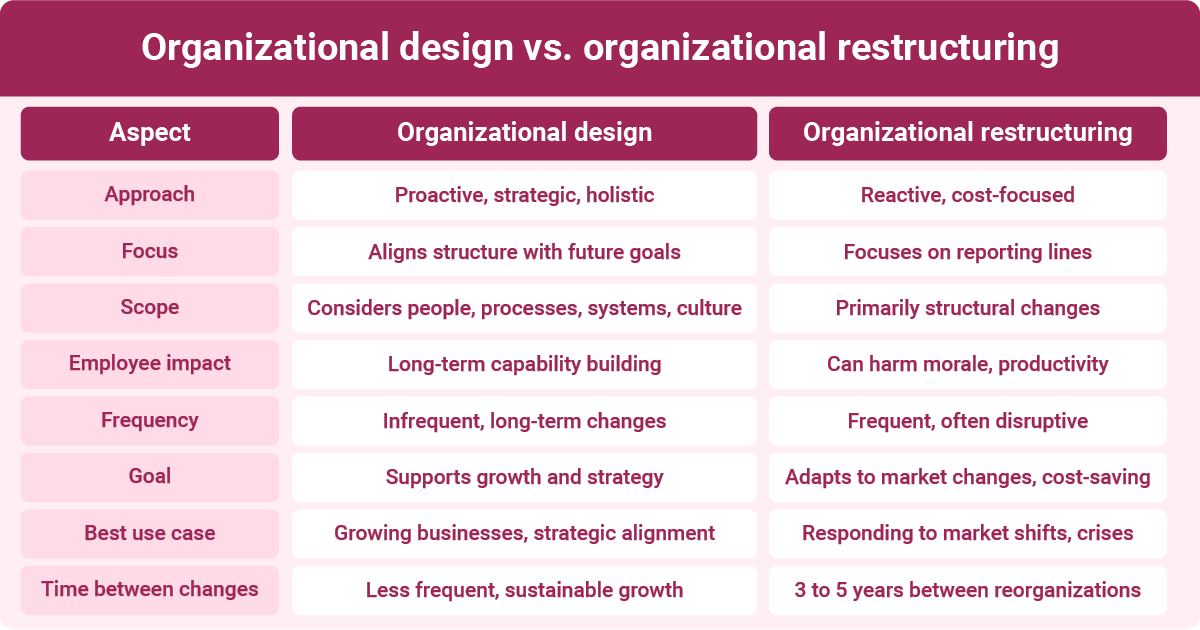
Organizational design is proactive, strategic, and holistic, aligning your structure with your future goals. It considers all elements of your organization, including people, processes, systems, and culture, to define the best structure to support strategy.
On the other hand, organizational restructuring is often reactive, prioritizing cost reduction or crisis response. This strategy focuses narrowly on reporting lines, ignoring the broader elements of organizational design.
Restructuring transitions can require a lot of effort from employees, potentially impairing morale and productivity if done too often. According to the research paper, ‘Strategies for Effective Organizational Restructuring: A Comprehensive Guide’, published in SSRN, you should wait three to five years before full-scale reorganizations.
Distinguishing organizational restructuring from organizational design can help you identify how you are addressing your structural issues. While both strategies require change management, good design generally reduces the need for frequent restructuring by emphasizing long-term capability building.
A case study, ‘Organization Design: Current Insights and Future Research DirectionsOpens in a new tab’, published in Sage Journals' Journal of Management, found that organizations benefited differently from organizational design and restructuring strategies, depending on their needs. Proactive design provided more control and configuration over growing businesses. Meanwhile, reorganization strategies helped businesses adapt to new market shifts and technologies, such as AI.
How to implement organizational design: a step-by-step process
Follow these organizational design steps to develop and implement an effective workflow.
Step 1: Align design with business strategy
Start by defining your strategic priorities, such as growth, innovation, cost leadership, customer intimacy, and competitive pressures. Clarifying your business objectives lets you identify the capabilities required to execute your strategy.
Consider how different structures and frameworks can enable or hinder these capabilities. Engage executive leadership, HR, and other teams to ensure the framework you choose aligns with your broader goals.
Step 2: Diagnose the current organizational state
Conduct stakeholder interviews and surveys to identify pain points, bottlenecks, and misalignments negatively impacting workflows and employee experiences. Map your current workflows, decision-making processes, and information flows to assess gaps between your current structure and your strategic needs. Frameworks such as the McKinsey 7S and Galbraith's Star Model can guide your diagnoses to maximize your actionable insights.
Step 3: Design the target organizational model
Select or customize a structural model, such as a functional, divisional, matrix, or hybrid design. Next, use a Responsible, Accountable, Consulted, and Informed (RACI) matrix to define decision rights, roles, and responsibilities, and within your selected framework.
Establish reporting lines, spans of control, and governance mechanisms to set clear expectations for operations. Finally, create supporting processes, performance metrics, and reward systems to elevate engagement, utilizing modern talent management practices whenever possible.
Step 4: Plan and execute the transition
Develop a phased implementation plan with clear milestones, sequence changes, and measurable goals. Communicate the purpose of your new design with your teams to increase transparency and reduce potential resistance. Train managers for new roles and decision-making authorities, and prepare to address employee concerns about role changes or redundancies.
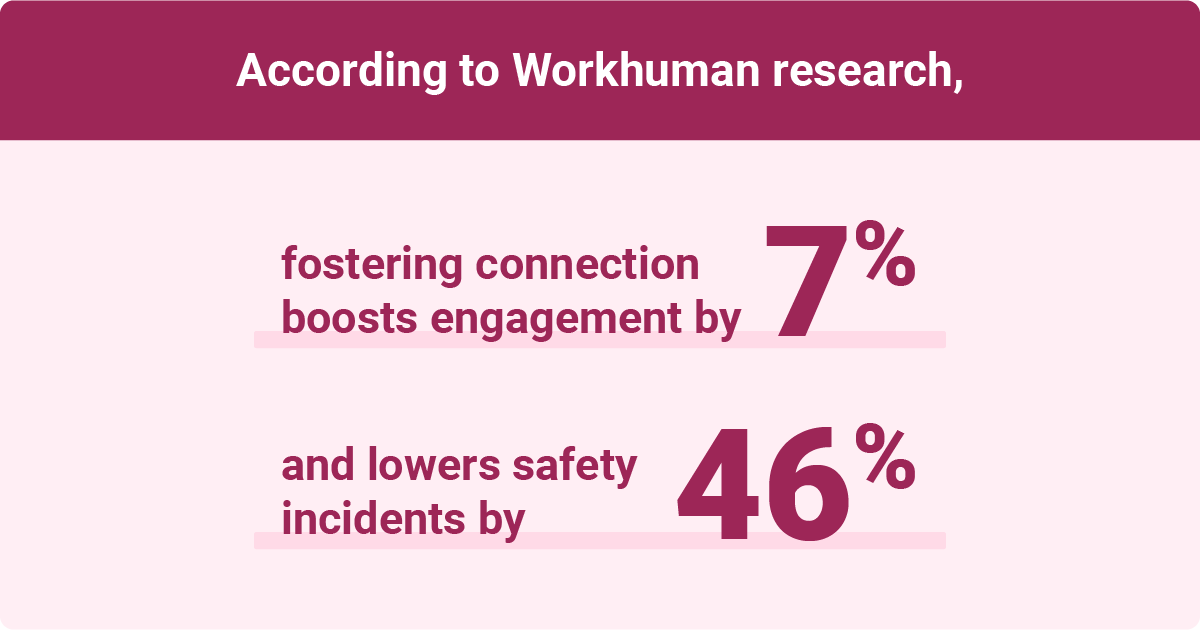
Workhuman's Community Celebrations can support team cohesion and belonging during organizational transitions. Workhuman® research reveals that connection can increase engagement by 7% and reduce safety incidents by 46%, which are crucial during big changes.
Learn how Community Celebrations® enables everyone to share their celebrations, regardless of their nature, whether personal, cultural, or work-related. Sharing joy on a larger scale makes the event more memorable.
Change management: preparing individuals and teams for organizational change
Organizational design changes can trigger uncertainty, resistance, and productivity dips if not managed proactively. Use the following strategies to effectively implement your new organizational design:
- Communicate early and often: Clearly explain expectations, benefits, and timelines, and share updates when possible.
- Identify and prepare "change champions": Managers, supervisors, senior employees, and other influencers can effectively model new behaviors.
- Provide role-specific training: Provide training and resources to help employees understand their new decision rights, tools, processes, and collaboration norms.
- Offer transition support: Coaching, job aids, and forums for questions and feedback can help employees adapt to new processes.
- Acknowledge losses: Help employees grieve old roles, teams, or reporting relationships before embracing new ones.
Step 5: Monitor, measure, and iterate
According to the research paper titled ‘Digital twins of organization: implications for organization designOpens in a new tab’, you will need to continuously revise how you interpret your organizational structure, especially when experiencing disruptions or workflow changes. Utilizing people analytics tools and measuring outcomes, impacts, and other organizational trends can help you continuously improve structures, designs, and the support employees receive.
Track key performance indicators (KPIs) using Workhuman® and other solutions to measure your new design's success. Be prepared to adjust the design as needed based on real-world feedback and changing conditions.
Workhuman iQ™ and the AI Assistant support measurement of the desired outcomes for organizational design by analyzing recognition patterns for team engagement, collaboration effectiveness, skills distribution, and cultural alignment. Capabilities such as advanced analytics and personalized recommendations enable HR leaders to track design success indicators and connect structural changes to measurable outcomes.
Are you having trouble seeing insights through the data? Cut through the noise with Workhuman's AI AssistantOpens in a new tab.
Surfaces insights into people dynamics, cultural health, employee performance, and skills sourced straight from your employees. Use open-ended prompts to generate reports and highlights that can be quickly put into action.
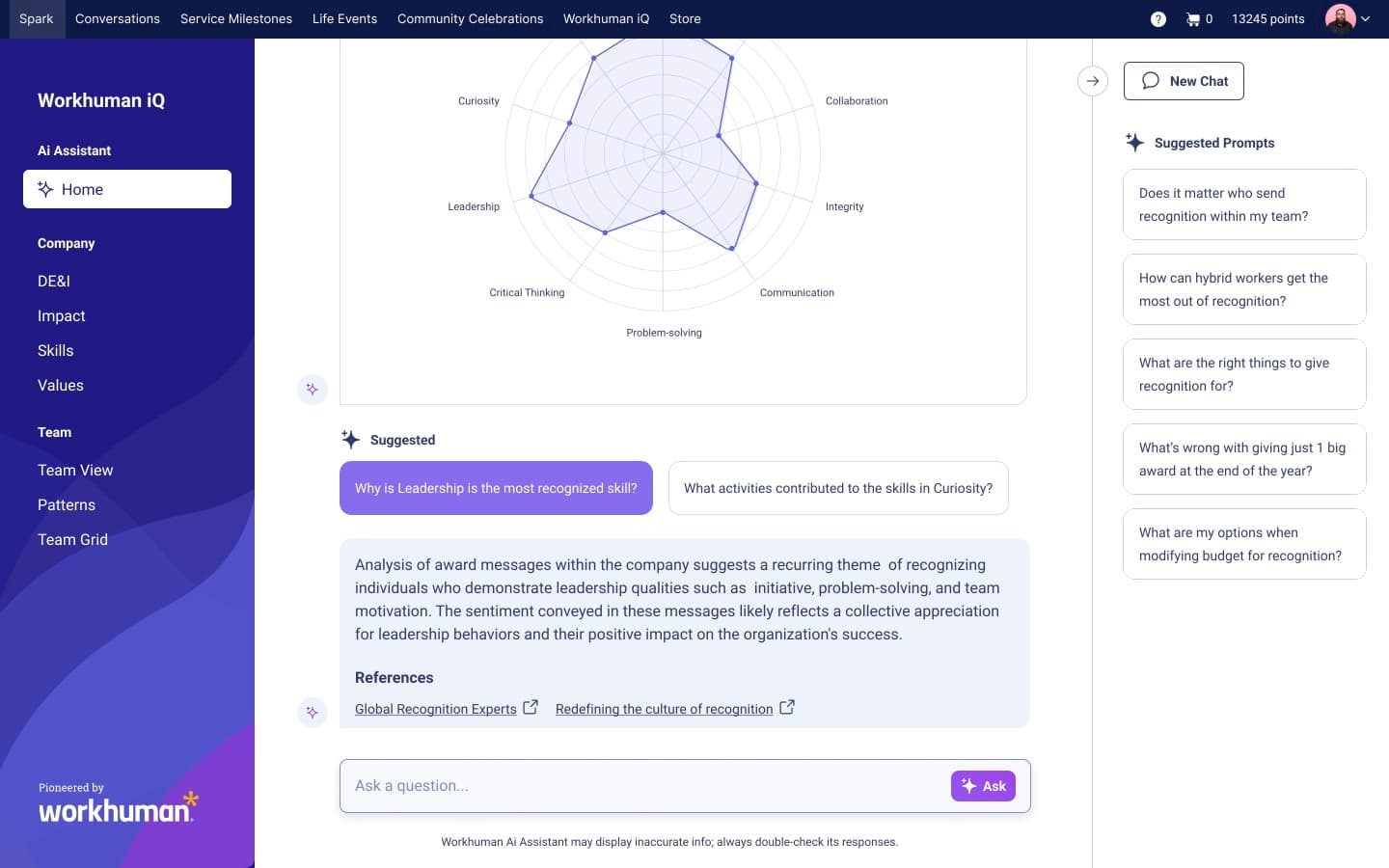
Get the measure of your organization. Harness the combined powers of AI and recognition—Human Intelligence™—to stay agile through the changing world of work.
Consider the following types of metrics for gauging organizational design success:
- Leading indicators: Predict future outcomes using decision speed, meeting efficiency, and role clarity surveys.
- Lagging indicators: Measure past performance and confirm trends using revenue growth, employee retention, and strategic goal attainment.
- Qualitative feedback: Use pulse surveys, in-the-moment feedback, and focus groups to understand your organization's non-quantitative elements.
Common organizational design challenges and mistakes to avoid
Design isn't a one-time organizational chart exercise – it's a holistic change across roles, processes, and systems. It involves implementing new ways of working that can sometimes be unpredictable. A research titled, ‘Transforming Mental Health Implementation ResearchOpens in a new tab’, published in The Lancet Psychiatry, reveals that implementation strategies often fall short when they aren't aligned with real-world political, cultural, community, and consumer landscapes.
Understanding common organizational design challenges can help you reduce the risks in your design, proactively prepare for setbacks, and support smooth implementation.
Typical pitfalls in organizational design
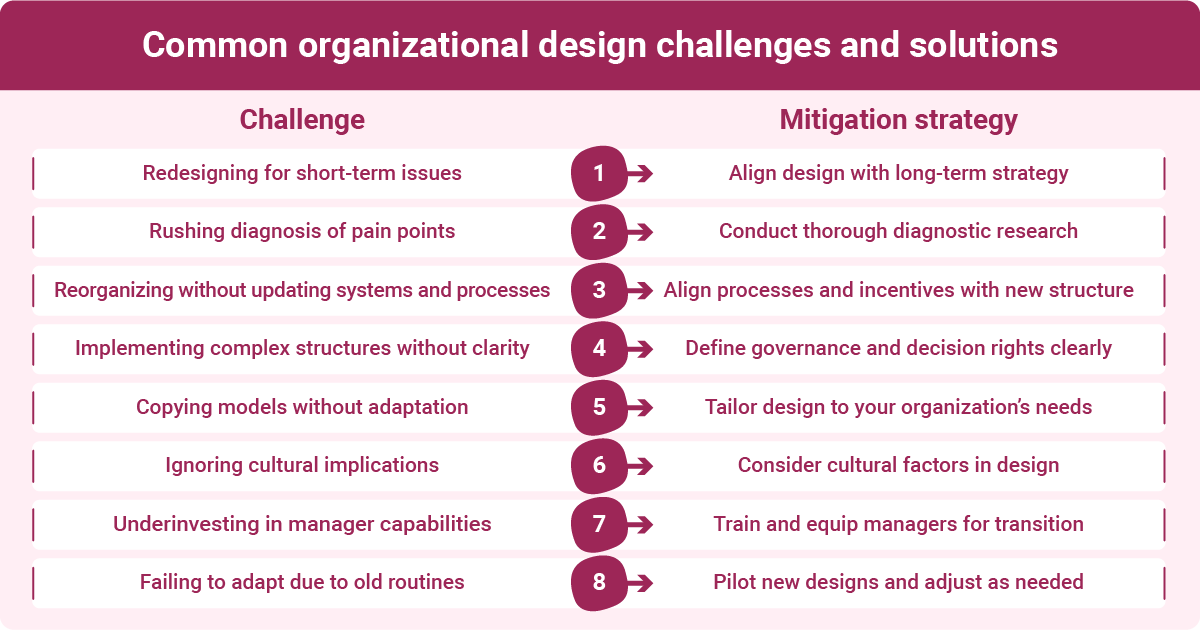
Common mistakes when redesigning an organization include:
- Launching a redesign primarily to address short-term symptoms, such as slow decisions, without linking choices back to strategy
- Skipping or rushing diagnosis, reducing your understanding of current pain points, workflows, and cultural dynamics
- Reorganizing reporting lines without updating underlying processes, systems, and incentives
- Introducing complex structures, such as matrix or hybrid models, without clarifying governance, decision rights, and accountability
- Copying another company’s structure or a popular model without adapting it to the organization’s specific strategy, size, and culture
- Overlooking cultural implications, such as how trust levels, leadership style, and norms around autonomy interact with new structures
- Underinvesting in managers' capabilities and skills, leaving frontline leaders unprepared to lead through the transition
A case study titled, ‘Two canoes: a case study in organizational change failure and the implications for future population health initiativesOpens in a new tab’ published by the University of Iowa focused on an organization that failed to adopt a new hybrid model after following the same embedded routines and processes for years. The team failed to implement the new structure because it didn't take the time to understand its initial organizational landscape to tailor the project accordingly.
How to address and mitigate common challenges
To address these common design challenges, start by developing a structured diagnostic with qualitative and quantitative data on performance, workflows, and employee experience. Follow these key strategies to reduce friction within your new design:
- Explicitly connect your design choices to strategic goals and critical capabilities, and document the rationale for your design.
- Define success metrics and KPIs upfront.
- Develop a clear change management plan covering communication, training, and feedback channels.
- Pilot new structures or ways of working in select teams or business units before scaling, such as by implementing the design in phases.
- Schedule regular reviews to assess the design's success and identify where adjustments are needed.
Organizational design for lifecycle stages and remote/hybrid
Context matters. Remote work and startup environments require tailored design approaches that differ from traditional office-based or mature organizations. Explore the key organizational design considerations for remote teams and diverse business lifecycles, with practical HR strategy examples.
Designing organizations for remote and hybrid work
Try out the following practices for strategic workforce planning for remote and hybrid organizational structures:
- Maintain group decisions: Establish clear decision-making protocols to replace hallway conversations.
- Support cross-functional collaboration: Invest in collaborative tools and asynchronous communication practices.
- Establish expectations: Define explicit work hours, response time expectations, and meeting norms.
- Centralize data: Build redundancy in communication channels to prevent information silos.
- Bridge the physical gap: Consider geographic clusters or hub-and-spoke models for roles that require high collaboration.
Integration capabilities enable distributed teams to stay connected without adding friction. For instance, Workhuman's® integrations with Microsoft Teams, Slack, and Workday enable recognition and feedback within existing collaboration platforms. This reduces the risk of information silos in remote work structures.
Workhuman® data shows that employees are three times more likely to feel connected to culture when recognition is embedded in their workflows.
Professionals, organizations, and HR leaders can always learn more about DEI. Diversity in a workplace must develop into a culture. Read 'Workhuman Cloud: The Bridge Between DE&I to build a holistic work culture.'
Design considerations across organizational lifecycle stages
Consider different design strategies based on your organization's current lifecycle stage:
- Startup stage (0-50 employees): Use a flat, informal, founder-driven design that focuses on survival and product-market fit.
- Growth stage (50-500 employees): Add functional specialization, formalize processes, and introduce middle management.
- Maturity stage (500+ employees): Optimize your design for efficiency, balance innovation with cost control, and consider divisional or matrix structures.
- Decline or turnaround stage: Simplify, cut layers, and refocus on core capabilities. This stage often requires painful restructuring.
FAQs
What tools are available for organizational design practitioners?
The top organizational design tools include:
- Organizational design software: Tools such as Lucidchart, Miro, and OrgChartNow map structures and visualize changes.
- Diagnostic assessments: Surveys and maturity models assess your design's current state.
- RACI matrix templates: Clarify decision rights and reduce role ambiguity during transitions.
- Span-of-control calculators: Determine optimal manager-to-report ratios by role complexity.
- Change readiness assessments: Measure employee and manager readiness before implementation.
- Consulting frameworks and guides: Leverage free resources from McKinsey, Deloitte, Korn Ferry, and academic institutions.
- HR information systems (HRIS): Platforms such as Workday and SAP SuccessFactors support organizational modeling and workforce planning.
How do I measure the success of an organizational design initiative?
Track both efficiency metrics – such as cost per full-time equivalent and decision cycle time – and effectiveness metrics – such as goal attainment and innovation output. Employee engagement, role clarity, and collaboration quality serve as leading indicators of design success, often shifting before financials do. Financial outcomes, such as revenue growth, profitability, and market share, are also critical indicators of whether design choices support strategy.
What are the steps in the organizational design process?
The five organizational design steps include:
1. Align design with business strategy.
2. Diagnose the current organizational state.
3. Design the target organizational model.
4. Plan and execute the transition.
5. Monitor, measure, and iterate.
What factors affect organizational design decisions?
Linking your organizational design to your business outcomes requires you to consider several key factors, including:
- Revenue growth
- Profitability
- Customer satisfaction
- Innovation Output
- Longitudinal data
About the author
Ryan Stoltz
Ryan is a search marketing manager and content strategist at Workhuman where he writes on the next evolution of the workplace. Outside of the workplace, he's a diehard 49ers fan, comedy junkie, and has trouble avoiding sweets on a nightly basis.