
Skills Taxonomy: The Key to Building a Future-Ready Workforce
Last updated
7 min read

Table of contents
- What is a skills taxonomy?
- Differentiating related concepts
- What are the benefits of implementing a skills taxonomy?
- How do you build a skills taxonomy?
- Leveraging technology and tools
- Maintaining and updating the skills taxonomy
- Implementing skills taxonomy in recruitment
- Best practices for effective skills taxonomy
- Conclusion
Share this article
It’s no secret that Artificial Intelligence (AI) and other technologies are shaking up workforces in every industry. According to the "Future of Jobs Report" by the World Economic Forum, employers estimate that 44% of workers will experience significant skill disruptions in the next five years.
That statistic might seem daunting, but it’s not all doom and gloom. In fact, this trend offers fresh opportunities for organizations to expand their employees' skill sets.
Developing a skills taxonomy is key to understanding your organization’s existing strengths and identifying skill gaps. It also helps you to make more strategic hiring decisions based on the skills you need today – and tomorrow.
What is a skills taxonomy?
A skills taxonomy is a structured framework that defines, categorizes, and organizes skills within an organization. It groups related skills into hierarchical categories, making it easier to identify, develop, and deploy talent effectively.
Think of it like the taxonomies you learned about in biology—where species are sorted into families and classes. In the workplace, a skills taxonomy works the same way. A marketing agency, for example, might categorize skills under content creation, which could include copywriting, SEO, and video production. A software company, on the other hand, might have categories for programming languages or cloud computing.
Organizations use skills taxonomies to align their workforce’s capabilities with business goals. If your company aims to lead in AI, for instance, you’ll need employees skilled in data engineering, machine learning, and prompt engineering. By structuring these competencies in a clear taxonomy, businesses can better assess skill gaps, guide training initiatives, and future-proof their workforce.
Purpose and significance
At first, a skills taxonomy might seem unnecessary. After all, shouldn’t you already know what skills your employees have? However, this tool is invaluable for workplace planning.
When it comes to upskilling and reskilling employees, a detailed skills taxonomy helps you pinpoint gaps in your workforce and address them quickly. For example, if you see your organization lacks strong communication skills, you could offer public speaking workshops. Or, you might hire new employees who excel in these areas.
Plus, a skills taxonomy can improve organizational agility. Say a new technology suddenly becomes critical in your industry. With a skills taxonomy, you can quickly identify employees who already have the right knowledge to take advantage of this trend.
Differentiating related concepts
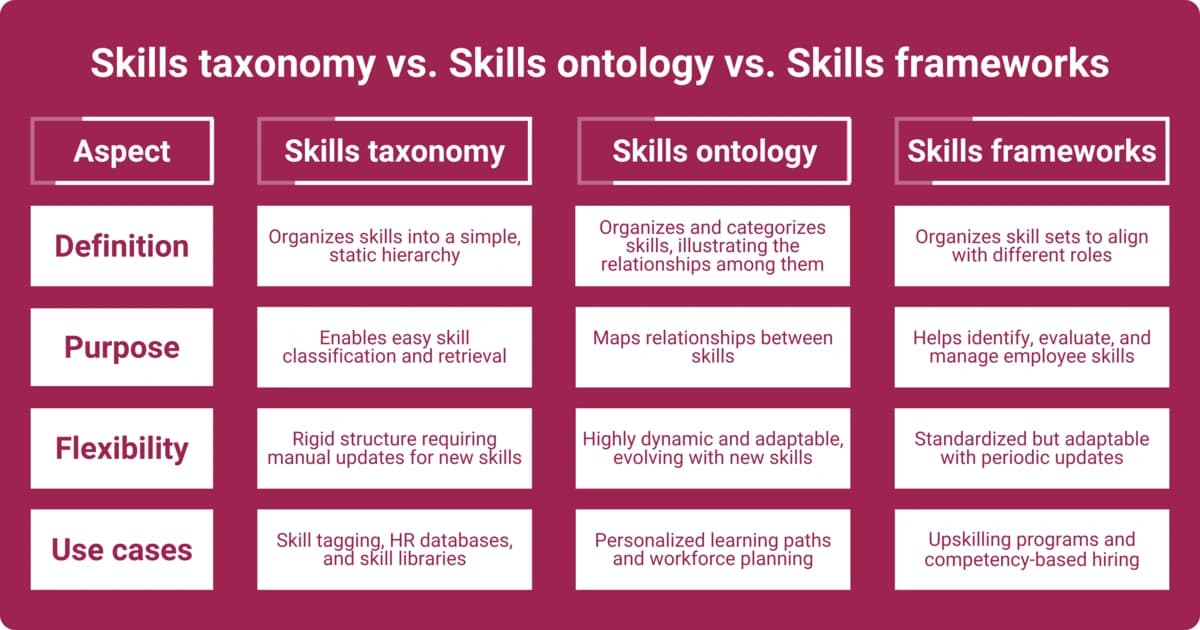
If you’re involved in workforce development, you’ve probably encountered terms like skills ontology and skills frameworks. While they’re related to skills taxonomy, these concepts play different roles in nurturing talent.
Skills taxonomy vs. skills ontology
Complexity is the key difference between a skills taxonomy and skills ontology. A taxonomy organizes skills into a simple and static hierarchy. In contrast, a skills ontology maps skills as an ever-changing web, highlighting the relationships between skills and roles.
Both skills intelligence tools allow you to conduct a detailed skills inventory assessment. However, a skills ontology goes a step further by helping you identify related skills, such as data visualization and statistical modeling. That way, you can develop more comprehensive training programs and match employees to projects that fit their skills.
Skills taxonomy vs. skills frameworks
Like a skills taxonomy, skills frameworks list an individual’s or organization’s abilities. Frameworks furthermore measure proficiency levels in each skill, from beginner to expert. Use these tools to give personalized feedback and recognize your employees’ unique strengths.
What are the benefits of implementing a skills taxonomy?
In the modern workplace, a skills taxonomy is an indispensable tool. Here are a few reasons why many organizations are embracing it.
Promoting a skills-first culture
While many jobs still require advanced education and degrees, employers are increasingly prioritizing skills over formal qualifications. According to the National Association of Colleges and Employers Job Outlook 2025 report, over half of employers use skills-based hiring always (13.7%) or most of the time (38.7%).
Facilitating targeted upskilling and reskilling
While many businesses are eager to embrace new technologies, they often fail to prepare their employees for these changes. For instance, a 2024 Workhuman and Gallup report found that 47% of organizations using AI don’t offer any training opportunities.
A skills taxonomy helps pinpoint skill gaps so you can design the most relevant and effective training programs. That way, you won’t waste time developing data analysis workshops when your employees actually want to learn how to improve productivity with AI – or vice versa.
Enhancing internal mobility and workforce agility
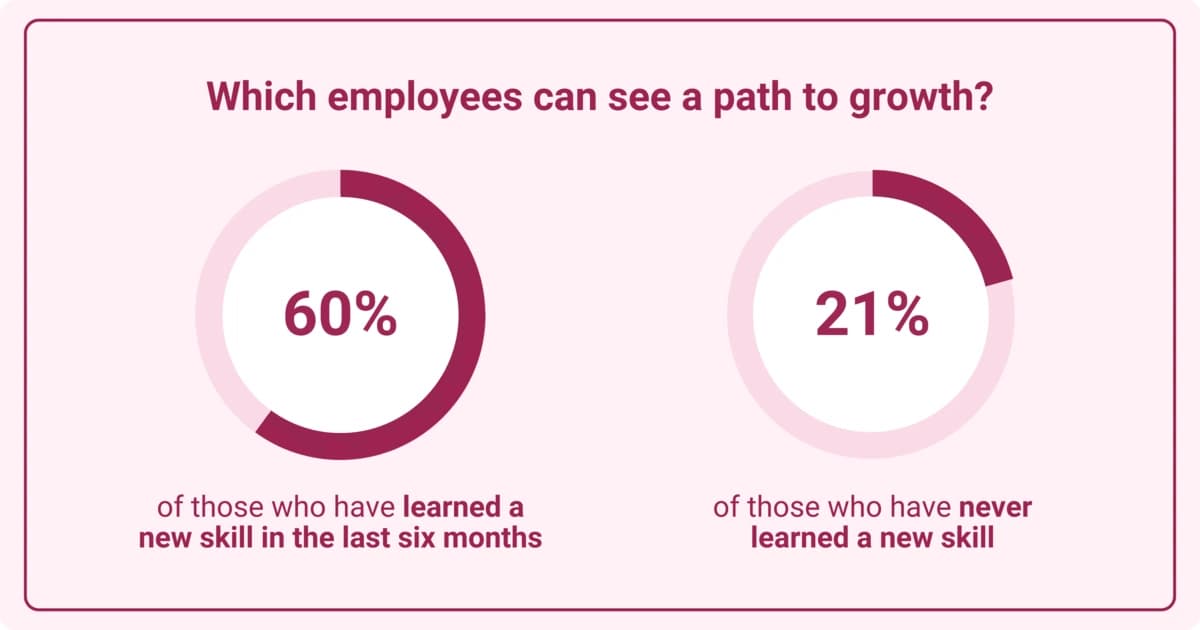
It’s not always easy for employees to spot opportunities for growth, especially when they’re focused on a single career path. By categorizing and mapping skills, you can help workers transition into new roles and adapt to your business’s changing needs. For example, a business analyst with strong communication and time management skills might excel as a project manager.
Supporting Diversity, Equity, and Inclusion (DEI)
Employees don’t all start on an even playing field. Some have attended elite colleges, while others may not have had the opportunity for a formal education.
A taxonomy helps you assess all employees fairly by focusing on their abilities rather than their credentials. With this skills-based approach, you can offer equal opportunities to candidates from diverse backgrounds.
How do you build a skills taxonomy?
Developing an effective skills taxonomy doesn’t have to be complicated or stressful. Follow these steps to create a comprehensive framework.
Identifying core skills
Every organization relies on key skills to achieve success. Take a close look at your goals and operations to identify these essential abilities. For example, a tech startup needs coding and web development skills to create applications, while a construction company requires project management skills to finish jobs on time.
Categorizing skills effectively
Every taxonomy needs clear and logical categories – otherwise, it’s just a random jumble of skills. Start by sorting abilities into two categories: interpersonal and technical skills. From there, you can create subgroups based on specific job requirements or areas of expertise.
If you run a marketing firm, a basic skills taxonomy might look something like this:
Aligning skills with organizational goals
It’s tempting to map every skill in your organization but resist the urge to go down this rabbit hole. Instead, keep your taxonomy relevant by focusing on the abilities that align with your business’s overall goals.
Collaborating with stakeholders
Even if you know your organization inside and out, it’s easy to overlook critical skills. Looping in stakeholders such as managers and employees will allow you to create the most accurate and thorough skills taxonomy.
Leveraging technology and tools
While there’s no replacement for your team’s first-hand experiences, these digital tools can help you create an insightful, scalable skills taxonomy.
Advanced platforms for skills management
Skills management platforms help organizations track, analyze, and optimize their workforce’s capabilities. They not only provide visibility into employee skills but also leverage data to conduct skills gap analyses, ensuring businesses stay agile and competitive.
Integrating AI and machine learning
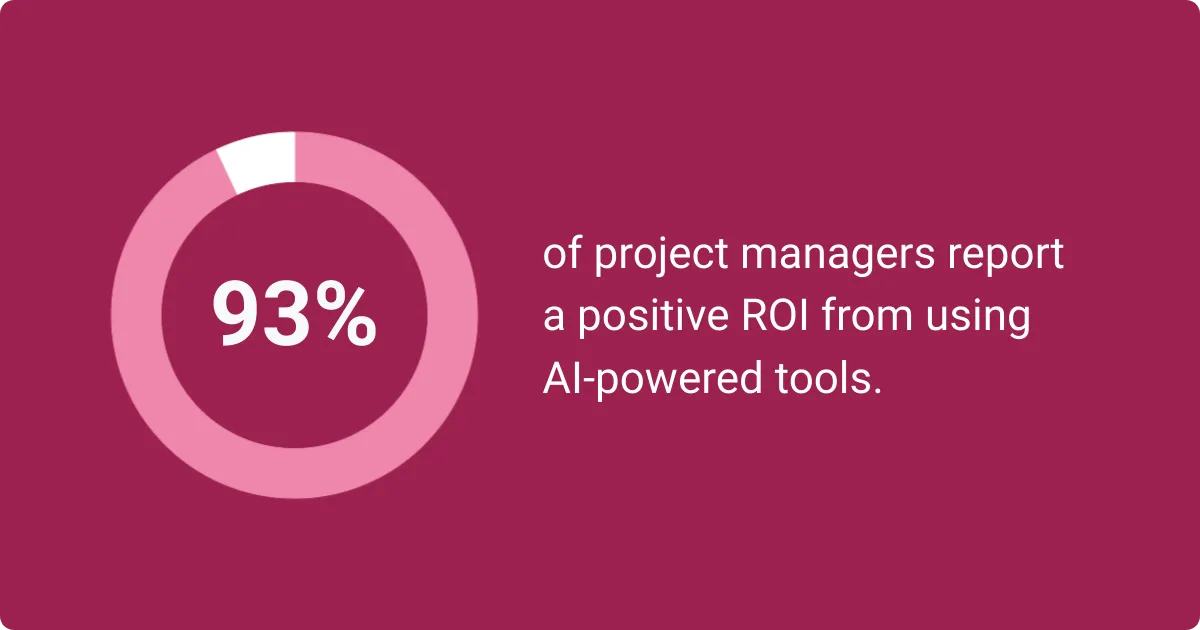
Analyzing employee data manually can be time-consuming, especially for large organizations. AI and machine learning algorithms can speed up this process and uncover surprising insights. For example, you could use AI to evaluate your team’s performance and identify training needs.
Maintaining and updating the skills taxonomy
Creating a skills taxonomy isn’t a one-and-done task. Ideally, this taxonomy should be a living document that continually evolves and expands as your organization’s needs change.
Conducting regular skills gap analyses
It’s natural for your workforce’s skills to change over time. For example, employees’ once-stellar collaboration skills might get rusty if they stop working in groups regularly. Periodic assessments help identify missing or underdeveloped skills so your taxonomy stays accurate.
Evaluating industry trends and changes
Your industry isn’t static, so your skills taxonomy shouldn’t be, either. Frequent updates will help your organization keep up with the latest trends and tools. For example, strengthening your employees’ AI skills can give you an edge over less agile competitors.
Engaging employees in the process
Your employees are an excellent resource when developing your skills taxonomy – after all, they’re deeply familiar with their roles and the skills they need to fulfill them. By inviting their insights and feedback, you can develop the most accurate and relevant framework.
Implementing skills taxonomy in recruitment
Strategic workforce planning begins with recruiting the right talent. A skills taxonomy helps HR professionals and hiring managers choose the best candidates.
Attracting talent with precise skill requirements
Spend a few minutes browsing job postings in your industry, and you’ll almost certainly come across vague descriptions. For example, a copywriter ad might only request “good grammar,” while a software developer posting may not specify the necessary programming languages. Job seekers might skip these postings if they can’t see how their skills fit.
With a skills taxonomy, you can clearly define the exact skills needed for each role. The more detailed and accurate your job posting, the more likely you are to attract the right candidates.
Assessing candidates based on skills
Evaluating candidates can be tricky, especially when you’re only relying on resumes and interviews. Plus, unconscious bias poses an ever-present threat – is Candidate A really the best, or do you prefer them because they went to your alma mater?
Skills-based assessments allow you to evaluate candidates fairly and objectively. They can also level the playing field for people who might not stand out in traditional interviews – such as those with certain disabilities – but excel in the necessary areas.
Creating skill-based job descriptions
Refer to your organizational skills taxonomy whenever you write job descriptions. Focus on the big-picture abilities that align with your business’s overall goals. For example, you might value analytical thinking and creativity for employees at all levels, from the entry level to the C-suite.
Best practices for effective skills taxonomy
Even the best skills taxonomy won’t help your organization if you don’t implement it effectively. Here are our top strategies for adopting and maintaining this framework.
Continuous learning and improvement
Developing a great skills taxonomy can feel incredibly satisfying, but don’t rest on your laurels. You’ll need to regularly revise your taxonomy if you want it to remain effective.
Employee-driven learning can keep your taxonomy updated and relevant. Encourage your workers to identify areas of growth and take ownership of their professional development. This could involve employees requesting new upskilling opportunities, such as a workshop on automation or team-building exercises.
Incorporating feedback loops
Creating a skills taxonomy should be a team effort. After all, no single person can fully understand the intricacies of every role, especially in huge corporations.
Engage your entire workforce by inviting employees and managers to provide feedback. Offer several ways to share insights to help everyone feel comfortable contributing. For example, you could host in-person focus groups with managers while giving employees the opportunity to offer their thoughts through an anonymous survey.
Once you’ve gathered feedback, use it to improve your taxonomy’s accuracy and usability. For instance, your original list might include video editing, but your marketing team may suggest that animation skills are more appropriate.
Your skills taxonomy should also inform the feedback you give to employees. Use it to develop tailored development plans and identify potential career paths. For example, a customer service representative who excels at conflict resolution may be on track for a management position. And, of course, be sure to point out the areas where employees are excelling to boost their confidence and build trust.
Ensuring accessibility and clarity
Without careful planning, a skills taxonomy can easily turn into a confusing or unwieldy mess. A sprawling hierarchy with hundreds of overlapping skills can be difficult to read or make use of. Or, even worse, a taxonomy that’s so vague none of your employees can figure out how it applies to them.
Avoid these issues by creating an accessible, user-friendly design. Use a logical and simple hierarchical structure that’s easy for stakeholders to navigate. For even more clarity, consider color-coding specific categories – like blue for communication skills, red for AI abilities, and so on. This approach will help users quickly locate relevant skills and understand the relationships between categories.
Conclusion
A skills taxonomy allows you to zoom out from an individual worker's skill set and gain fresh insights into your entire workforce’s abilities. Get started by creating a list of the most critical skills in your organization. You may find it helpful to peruse your organization’s job descriptions to see which abilities appear frequently. Once you’ve developed a preliminary taxonomy, ask your team for feedback to help you perfect it.
By identifying and categorizing essential skills, you’ll better understand your employees’ strengths, allowing you to spot skill gaps and develop more effective training programs to address them.

Workhuman Editorial Team
More by Workhuman Editorial TeamRecommended for you