
2026 Best Team-Building Activities for the Workplace: Ideas That Improve Connection and Collaboration
by Ryan Stoltz
Last updated
19 min read

Table of contents
- Team building activities by type
- Types of team-building activities for work
- Benefits of team-building exercises in the workplace
- Key considerations when choosing team-building activities
- How to measure the success of team-building activities
- Building stronger teams for lasting success
Share this article
"Team building" is a term that makes some people cringe, but the positive effects of the practice itself – when done well – are indisputable.
Why is team-building important in the workplace? It encourages communication, trust, collaboration, and group cohesiveness. It relieves stress and enhances your team’s morale, productivity, engagement, and problem-solving skills. Ultimately, it leads to a stronger company culture and improved business results.
The best way to realize these benefits is through team-building activities – structured exercises and events designed to bring your team together into a cohesive unit with a united purpose, strengthen bonds among team members, and improve their ability to work together.
This is a detailed, actionable guide to various types of team-building exercises, emphasizing their impact in personal, professional, and leadership contexts and giving you the tools you need to activate the power of your team.
Team building activities by type
| Activity Type | Activity Name | Entertainment Level | Difficulty | Duration | Instructions | Impact |
| Icebreakers and Quick Activities | Two truths and a lie | Medium | Low | 10-15 minutes | Each person shares two facts and one falsehood about themselves. The team guesses which is the lie. | Builds trust and encourages open communication. |
| Human bingo | High | Low | 15-20 minutes | Create bingo cards with traits like "Has traveled to Asia" or "Speaks more than two languages." Team members must find someone who matches each trait. | Encourages team members to learn about each other and promotes social interaction. | |
| Quickfire questions | Medium | Low | 5-10 minutes | In a quick, timed session, ask random questions, like “What’s your favorite book?” or “What’s the best vacation you’ve had?” | Fast-paced and engaging, helps people get to know each other quickly and comfortably. | |
| Guess who? | Medium | Low | 10-15 minutes | Everyone writes down a little-known fact about themselves. Others must guess which fact belongs to whom. | Encourages sharing and improves team members’ knowledge of each other. | |
| Icebreaker polls | Low | Low | 5-10 minutes | Use online tools to conduct quick polls (e.g., "What's your favorite weekend activity?"). Share the results in real time. | A simple way to start a conversation and break the ice. | |
| Problem-solving and Collaboration Activities | Escape room challenge | High | High | 30-60 minutes | Teams must solve puzzles and find clues to escape a locked room within a set time. | Improves collaboration, critical thinking, and communication under pressure. |
| Tower-building challenge | High | Medium | 20-30 minutes | Using limited materials (such as straws, paper, and tape), teams must build the tallest freestanding tower. | Fosters creativity, teamwork, and resourcefulness. | |
| Problem-solving challenge | Medium | High | 20-30 minutes | Present teams with a complex problem (e.g., a company dilemma) and ask them to devise a solution within a time frame. | Develops critical thinking, collaboration, and leadership skills. | |
| The marshmallow challenge | High | Medium | 15-20 minutes | Teams use spaghetti, string, and a marshmallow to build the tallest structure. The marshmallow must be on top. | Encourages teamwork, time management, and innovation. | |
| Brainstorming session | Low | Medium | 20-30 minutes | Teams work together to generate as many ideas as possible on a particular topic or problem. | Enhances creativity, team engagement, and decision-making. | |
| Social and Fun Team-Building Activities | Office trivia | High | Low | 10-15 minutes | Create trivia questions based on team members’ hobbies, favorite movies, or interesting facts. | Encourages learning about each other in a fun, relaxed atmosphere. |
| Charades | High | Low | 15-20 minutes | Divide into teams. One team member acts out a word or phrase while others guess. | Promotes laughter, team engagement, and creativity. | |
| Pictionary | High | Low | 20-30 minutes | Players draw a word or phrase while their teammates guess what it is. | Sparks creativity and teamwork in a fun setting. | |
| Musical chairs | Medium | Low | 10-15 minutes | Classic game where chairs are placed in a circle, and players walk around them until the music stops. | Lightens the mood and fosters team spirit. | |
| Virtual Team-Building Activities | Virtual coffee breaks | Low | Low | 15-30 minutes | Schedule regular virtual coffee breaks where team members can chat about non-work topics. | Helps remote teams build relationships and alleviate isolation. |
| Online team quizzes | High | Low | 10-15 minutes | Use platforms like Kahoot or Quizizz to create quizzes about team members' interests or general knowledge. | Enhances team bonding and promotes fun competition. | |
| Virtual escape room | High | High | 30-60 minutes | Organize a virtual escape room where team members solve puzzles and clues through video conferencing. | Enhances collaboration and communication, even in remote settings. | |
| Virtual icebreakers | Medium | Low | 10-15 minutes | Use icebreaker tools (like Jamboard or Miro) to introduce fun, engaging questions for teams to answer together. | Encourages social interaction in a digital environment. | |
| Virtual charades | High | Low | 15-20 minutes | Use a virtual meeting platform to play charades, with teammates acting out words for others to guess. | Brings fun and team spirit into virtual settings. | |
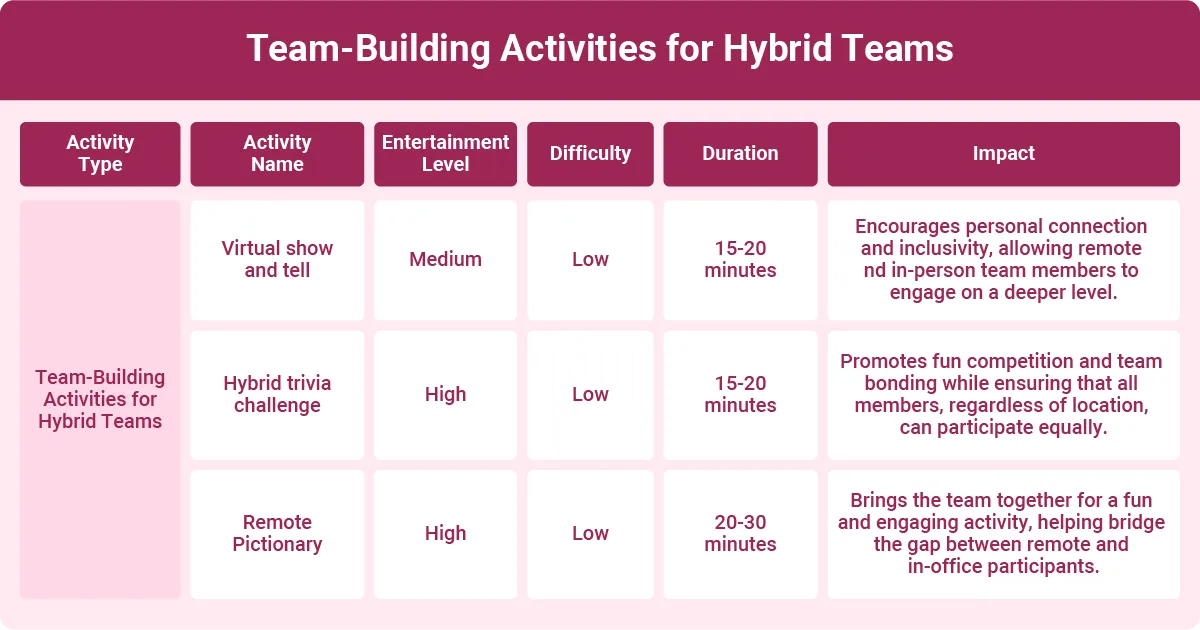
| Team-Building Activities for Hybrid Teams | Virtual show and tell | Medium | Low | 15-20 minutes | Team members take turns showing an object in their workspace or home that holds personal meaning and sharing its story with the team. | Encourages personal connection and inclusivity, allowing remote and in-person team members to engage on a deeper level. |
| Hybrid trivia challenge | High | Low | 15-20 minutes | Use a platform like Kahoot or Quizizz for a trivia session where both in-office and remote employees can participate in answering questions. | Promotes fun competition and team bonding while ensuring that all members, regardless of location, can participate equally. | |
| Remote Pictionary | High | Low | 20-30 minutes | Use a virtual whiteboard tool for a game of Pictionary, where team members draw and guess words or phrases in real time. | Brings the team together for a fun and engaging activity, helping bridge the gap between remote and in-office participants. | |
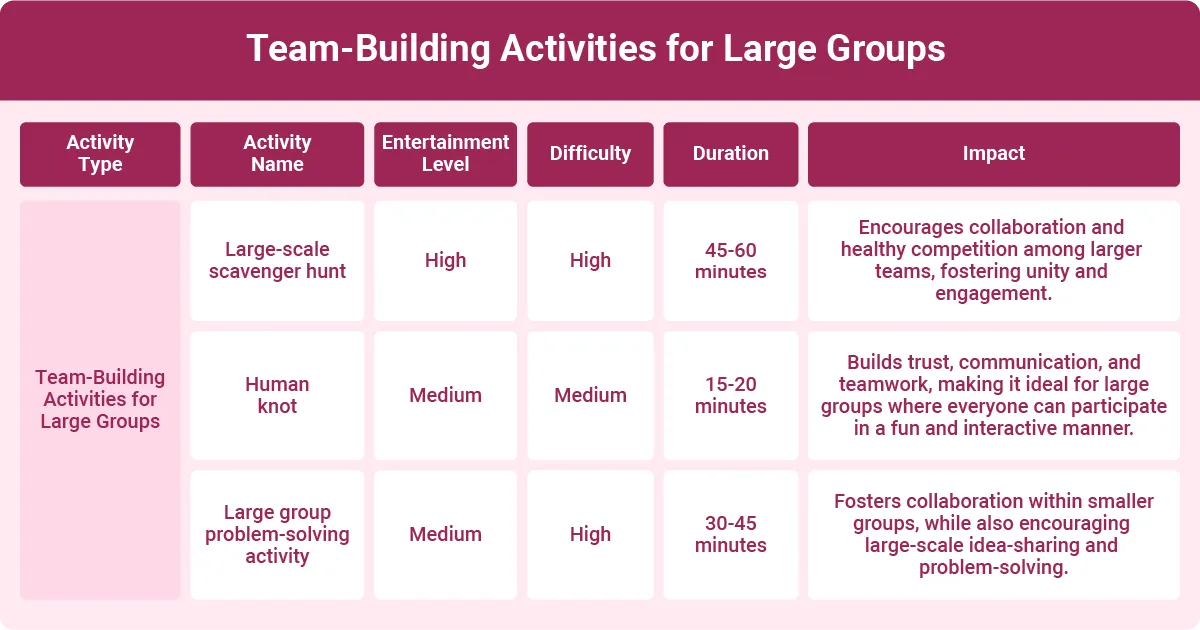
| Team-Building Activities for Large Groups | Large-scale scavenger hunt | High | High | 45-60 minutes | Organize a large-scale scavenger hunt in multiple locations or across various departments, with teams solving clues and completing challenges. | Encourages collaboration and healthy competition among larger teams, fostering unity and engagement. |
| Human knot | Medium | Medium | 15-20 minutes | Team members stand in a circle, reach across to grab two different people's hands, and must work together to untangle themselves without letting go. | Builds trust, communication, and teamwork, making it ideal for large groups where everyone can participate in a fun and interactive manner. | |
| Large group problem-solving activity | Medium | High | 30-45 minutes | Divide the large group into smaller teams, each working on a complex problem or case study, and then reconvene to present their solutions to all the group members. | Fosters collaboration within smaller groups, while also encouraging large-scale idea-sharing and problem-solving. | |
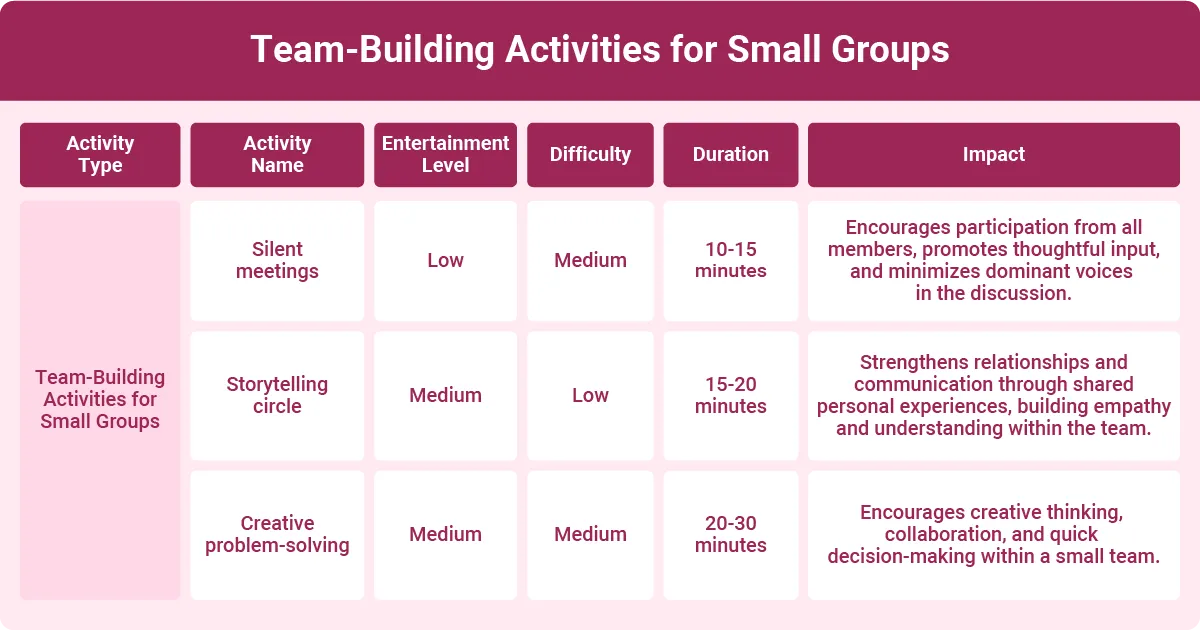
| Team-Building Activities for Small Groups | Silent meetings | Low | Medium | 10-15 minutes | Have team members write down their thoughts or ideas on a specific topic in a collaborative document or on a shared board without speaking. | Encourages participation from all members, promotes thoughtful input, and minimizes dominant voices in the discussion. |
| Storytelling circle | Medium | Low | 15-20 minutes | Team members sit in a circle and take turns telling a short personal story related to the theme of the meeting. | Strengthens relationships and communication through shared personal experiences, building empathy and understanding within the team. | |
| Creative problem-solving | Medium | Medium | 20-30 minutes | Present a workplace scenario or challenge and ask the small team to brainstorm and solve the problem together. | Encourages creative thinking, collaboration, and quick decision-making within a small team. | |
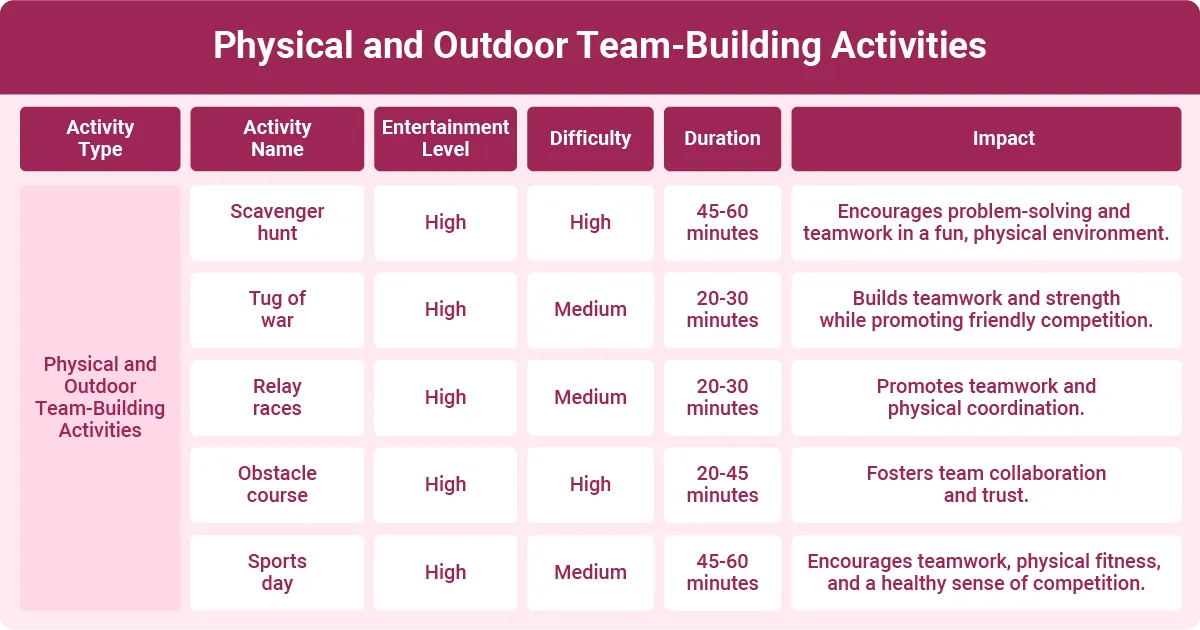
| Physical and Outdoor Team-Building Activities | Scavenger hunt | High | High | 45-60 minutes | Organize a scavenger hunt around the office or in an outdoor location with clues and tasks to complete. | Encourages problem-solving and teamwork in a fun, physical environment. |
| Tug of war | High | Medium | 20-30 minutes | Teams face off in a traditional tug-of-war competition. | Builds teamwork and strength while promoting friendly competition. | |
| Relay races | High | Medium | 20-30 minutes | Divide the team into groups and have them race in a relay format, completing different tasks at each station. | Promotes teamwork and physical coordination. | |
| Obstacle course | High | High | 30-45 minutes | Set up an obstacle course with physical challenges, such as crawling under ropes or jumping over hurdles. | Fosters team collaboration and trust. | |
| Sports day | High | Medium | 45-60 minutes | Organize a mini sports day with activities like sack races, three-legged races, and tug-of-war. | Encourages teamwork, physical fitness, and a healthy sense of competition. | |
| Indoor Team-Building Activities | Paper chains | Medium | Low | 30 minutes | Teams create colorful paper chains by adding links with written messages or team-related content, then share the results. | Encourages creativity, teamwork, and strengthens team bonding. |
| Book club | Low | Low | 30-60 minutes | Choose a book relevant to the team’s goals or interests. Schedule regular meetings for discussions and reflections. | Promotes thoughtful conversations, empathy, and intellectual engagement. | |
| Hack day | High | High | 4-8 hours | Organize a day dedicated to brainstorming, coding, or solving problems with teams competing to create the best solution or prototype. | Sparks innovation, teamwork, and problem-solving under time constraints. | |
| Connect the bridges | High | High | 45-90 minutes | Divide your team into groups, with each group building a section of a bridge using limited materials and communication. Then, try to connect the bridge sections. | Shows the importance of communication, collaboration, problem-solving, shared responsibility, creativity, and trust. | |
| Improv class | High | Medium | 1-2 hours | Harness the power of “Yes, and…” by organizing an improv workshop during which team members participate in collaborative games, practice active listening, and create scenes and stories together. | Strengthens bonds, encourages laughter and collaboration, improves adaptability and flexibility, and creates a feeling of belonging and agreement. | |
| Pairs | Medium | Low | 10-20 minutes | Come up with famous pairs, such as “salt and pepper,” “peanut butter and jelly,” “macaroni and cheese,” and so on, then write one half of each pair on a Post-it note. Stick a note on each team member’s back and encourage them to mingle and ask other teammates indirect questions to help them figure out what’s written on their backs. Finally, they should find the player whose note bears the other half of their pair. | Improves communication and interaction, promotes bonding and collaboration, and enhances problem-solving and creative thinking skills. | |
| Puzzle race | Medium | Medium | 20-45 minutes | Choose a physical or virtual puzzle, such as a jigsaw puzzle, a crossword, or a sudoku puzzle, and have individual team members or groups race to complete the puzzle fastest. | Exercises your team’s “mental muscles” and problem-solving abilities and, if completed in groups, also functions as an exercise in cooperation and collaboration. | |
| Recreate a game show | High | Medium | 45-90 minutes | Replicate a famous television game show, like Jeopardy, The Price Is Right, Family Feud, or Name That Tune. | Builds enthusiasm, energy, and engagement. |
Types of team-building activities for work
To help you with brainstorming team-building ideas for the workplace, we’ve sorted various team-building activities into several categories, from quick icebreakers to in-depth, collaborative problem-solving exercises to outdoor activities to bring your team together.
1. Icebreakers and quick activities
These team-building exercises help alleviate any initial awkwardness, set a positive tone, and facilitate quick connections among team members.
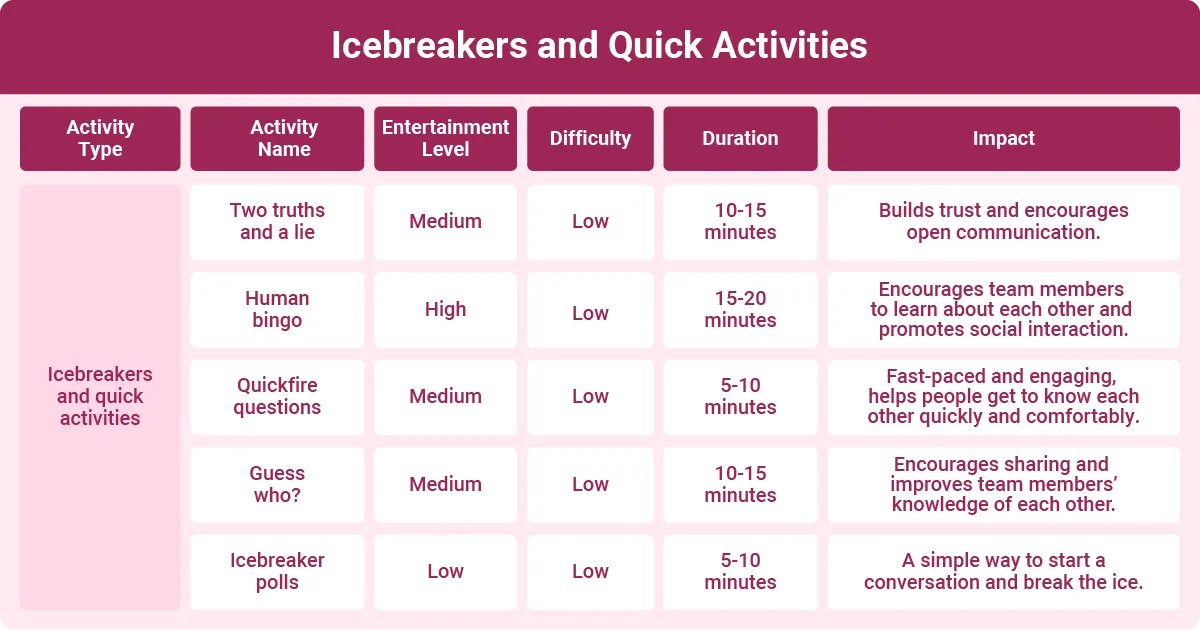
Two truths and a lie
Each person shares two facts and one falsehood about themselves. The team guesses which is the lie.
Impact: Builds trust and encourages open communication.
Human bingo
Create bingo cards with traits like "Has traveled to Asia" or "Speaks more than two languages." Team members must find someone who matches each trait.
Impact: Encourages team members to learn about each other and promotes social interaction.
Quickfire questions
In a quick, timed session, ask random questions, like “What’s your favorite book?” or “What’s the best vacation you’ve had?”
Impact: Fast-paced and engaging, this helps people get to know each other quickly and comfortably.
Guess who?
Everyone writes down a little-known fact about themselves. Others must guess which fact belongs to whom.
Impact: Encourages sharing and improves team members’ knowledge of each other.
2. Problem-solving and collaboration activities
Working on these problem-solving team-building activities together will enhance your team’s critical thinking skills, build trust and communication, and promote innovation and creativity.
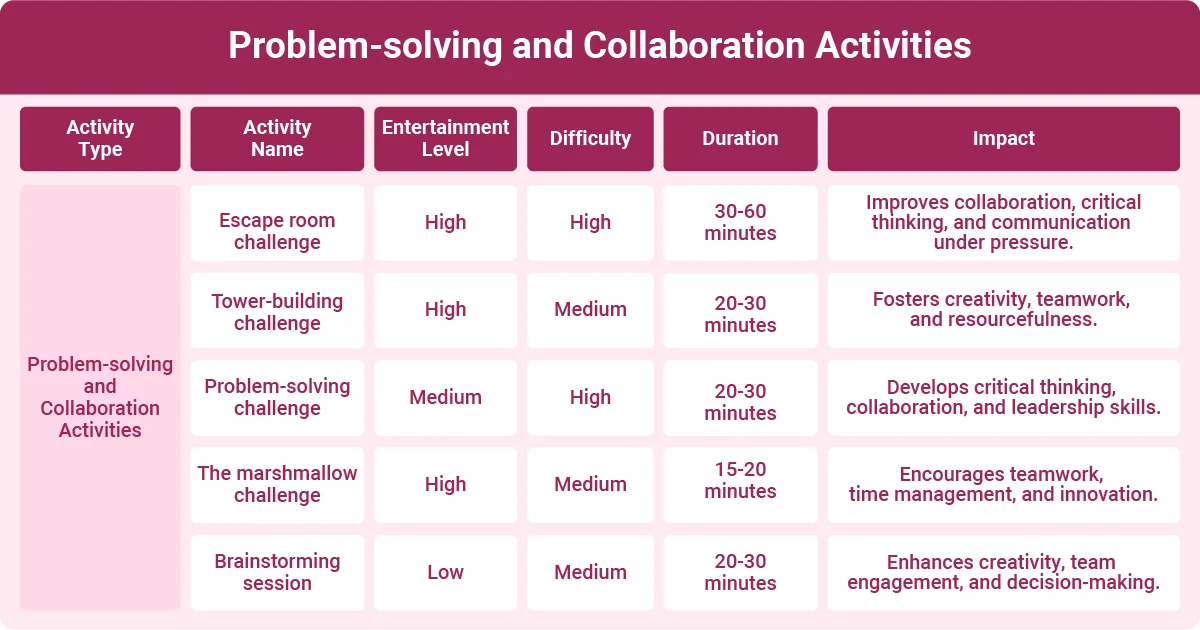
Escape room challenge
Teams must solve puzzles and find clues to escape a locked room within a set time.
Impact: Improves collaboration, strategic thinking, and communication under pressure.
Tower-building challenge
Using limited materials (such as straws, paper, and tape), teams must build the tallest freestanding tower.
Impact: Fosters creativity, teamwork, and resourcefulness.
Problem-solving challenge
Present teams with a complex problem (e.g., a company dilemma) and ask them to devise a solution within a time frame.
Impact: Develops critical thinking, collaboration, and leadership skills.
The marshmallow challenge
Teams use spaghetti, string, and a marshmallow to build the tallest structure. The marshmallow must be on top.
Impact: Encourages teamwork, time management, and innovation.
Brainstorming session
Teams work together to generate as many ideas as possible on a particular topic or problem.
Impact: Enhances creativity, team engagement, and decision-making.
3. Social and fun team-building activities
By playing these fun, social team games together, you will improve your team’s morale and engagement, fortify their bonds, and give your company culture a positive push.
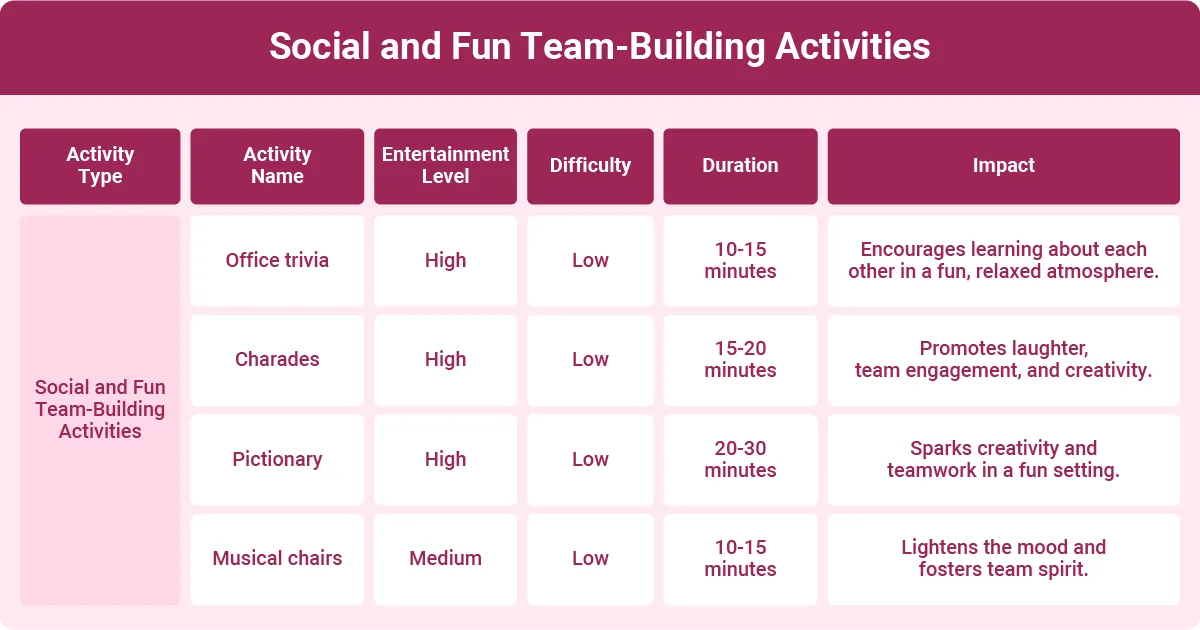
Office trivia
Create trivia questions based on team members’ hobbies, favorite movies, or interesting facts.
Impact: Encourages learning about each other in a fun, relaxed atmosphere.
Charades
Divide into teams. One team member acts out a word or phrase while others guess.
Impact: Promotes laughter, team engagement, and creativity.
Pictionary
Players draw a word or phrase while their teammates guess what it is.
Impact: Sparks creativity and teamwork in a fun setting.
Musical chairs
A classic team-building game where chairs are placed in a circle, and players walk around them until the music stops.
Impact: Lightens the mood and fosters team spirit.
4. Virtual team-building activities
Not every group works in the same room (or country). These team-building virtual activities help bridge the distance and foster communication among distributed teams.
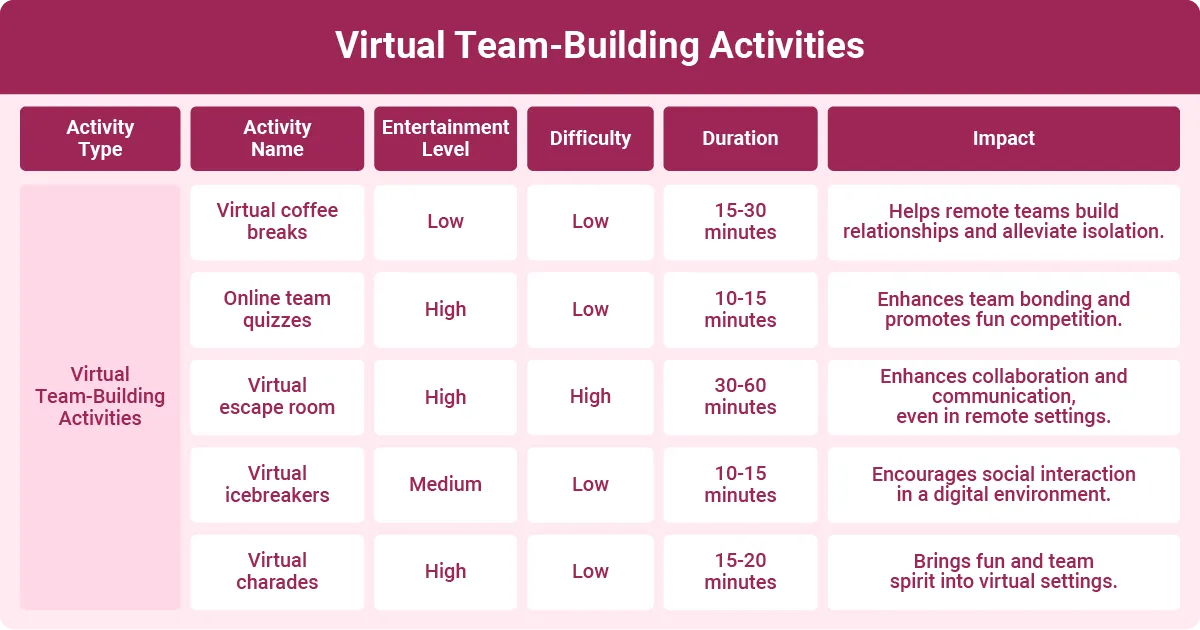
Virtual coffee breaks
Schedule regular virtual coffee breaks where team members can chat about non-work topics.
Impact: Helps remote teams build relationships and alleviate isolation.
Online team quizzes
Use platforms like Kahoot or Quizizz to create quizzes about team members' interests or general knowledge.
Impact: Enhances team bonding and promotes fun competition.
Virtual escape room
Organize a virtual escape room where team members solve puzzles and clues through video conferencing.
Impact: Enhances collaboration and communication, even in remote settings.
Virtual icebreakers
Use icebreaker tools (like Jamboard or Miro) to introduce fun, engaging questions for teams to answer together.
Impact: Encourages social interaction in a digital environment.
Virtual charades
Use a virtual meeting platform to play charades, with teammates acting out words for others to guess.
Impact: Brings fun and team spirit into virtual settings.
5. Team-building activities for hybrid teams
In hybrid teams, some members work remotely, while others work in the office. Team-building in such environments has a unique set of challenges.
- Communication and connection: Information gaps; lack of non-verbal cues; social silos
- Equity and inclusion: Unequal access to managers and resources; promotion bias; onboarding difficulties
- Culture and trust: Company culture weakened by lack of shared experiences; reduced trust; lower motivation and engagement due to feelings of invisibility and isolation
- Logistics and technology: Coordination challenges due to location and time zone differences; over-reliance on technology; remote worker burnout
Virtual show and tell
Team members take turns showing an object in their workspace or home that holds personal meaning and sharing its story with the team.
Impact: Encourages personal connection and inclusivity, allowing remote and in-person team members to engage on a deeper level.
Hybrid trivia challenge
Use a platform like Kahoot or Quizizz for a trivia session, where both in-office and remote employees participate in answering questions.
Impact: Promotes fun competition and team bonding while ensuring that all members, regardless of location, can participate equally.
Remote Pictionary
Use a virtual whiteboard tool for a game of Pictionary, where team members draw and guess words or phrases in real time.
Impact: Brings the team together for a fun and engaging activity, bridging the gap between remote and in-office participants.
6. Team-building ideas for large groups
Many team-building activities work better with smaller groups. Challenges managers face when planning team-building exercises for large teams include:
- Engagement and inclusion: Difficulties involving everyone without anyone feeling lost or excluded
- Logistics: Planning complexities for venue, materials, tech, and movement
- Communication breakdown: Frustrations about communicating instructions and ensuring everyone’s participation
- Lack of trust or connection: Trouble building deep bonds among dozens or hundreds of people
- Role confusion and conflict: More potential for interpersonal issues to develop and fester
However difficult, large groups benefit from these exercises, too. With strategic planning, your large team can participate, as long as you follow these best practices:
- Nail down the logistics: Book early; select comfortable venues in terms of space, temperature, and acoustics; and closely manage items like catering and transportation.
- Divide and conquer: Break the large group into smaller teams that allow everyone to participate in activities.
- Hire professionals: Many organizations hire specialized team-building training companies to help them maximize the impact of their activities.
- Focus on shared purpose: Design activities to create common ground and understanding rather than simply competition.
- Build to a crescendo: Structure team-building activities in a way that builds and sustains energy, ending the event on an emotional, memorable note.
- Select scalable activities: Choose games and challenges that enable many small teams to participate simultaneously.
These inclusive, scalable team-building activities for large groups will help sustain a high energy level throughout your team-building event.
Large-scale scavenger hunt
Organize a large-scale scavenger hunt in multiple locations or across various departments, with teams solving clues and completing challenges.
Impact: Encourages collaboration and healthy competition among larger teams, fostering unity and engagement.
Human knot
Team members stand in a circle, reach across to grab two different people's hands, and must work together to untangle themselves without letting go.
Impact: Builds trust, communication, and teamwork, making it ideal for large groups where everyone can participate in a fun and interactive manner.
7. Team-building games for small groups
Conducting team-building activities in smaller groups can simplify your event planning. Whether you have a small team to begin with or divide your team into smaller groups to participate in team-building exercises, the advantages of smaller groups include:
- Increased participation
- Deeper, more meaningful, and stronger connections
- More personal interactions
- More effective communication and learning
- Greater trust and safety
- A larger sense of accountability, autonomy, and flexibility
For a smaller group, these team-building activities are intimate and personalized, allowing everyone to feel included and useful.
Silent meetings
Have team members write down their thoughts or ideas on a specific topic in a collaborative document or on a shared board without speaking.
Impact: Encourages participation from all members, promotes thoughtful input, and minimizes dominant voices in the discussion.
Storytelling circle
Team members sit in a circle and take turns telling a short personal story related to the meeting's theme.
Impact: Strengthens relationships and communication through shared personal experiences, building empathy and understanding within the team.
Creative problem-solving
Present a workplace challenge and ask the small team to brainstorm and solve the problem together.
Impact: Encourages creative thinking, collaboration, and quick decision-making within a small team.
8. Physical and outdoor team-building activities
Why limit your team to sedentary exercises? Incorporating physical movement offers multiple advantages, such as:
- Improved mental health, creativity, and brain function
- Enhanced problem-solving and motivation
- Better communication, cohesion, and trust
- Stronger relationships and culture
- Reduced stress
- Better physical health, energy, and stamina
- Higher engagement and productivity
- Enhanced physical wellbeing
According to various sources, including McKinseyOpens in a new tab, Offsite, Bear Grylls Survival AcademyOpens in a new tab, and The Outdoors GroupOpens in a new tab, taking team-building activities outdoors enhances these benefits to a degree you can’t replicate in an office setting.
Scavenger hunt
Organize a scavenger hunt around the office or in an outdoor location with clues and tasks to complete.
Impact: Encourages problem-solving and teamwork in a fun, physical environment.
Tug of war
Teams face off in a traditional tug-of-war competition.
Impact: Builds teamwork and strength while promoting friendly competition.
Relay races
Divide the team into groups and have them race in a relay format, completing different tasks at each station.
Impact: Promotes teamwork and physical coordination.
Obstacle course
Set up an obstacle course with physical challenges, such as crawling under ropes or jumping over hurdles.
Impact: Fosters team collaboration and trust.
Sports day
Organize a mini sports day with activities like sack races, three-legged races, and tug-of-war.
Impact: Encourages teamwork, physical fitness, and a healthy sense of competition.
9. Indoor team-building games for work
With these team-building exercises you can conduct indoors, you can improve your team’s communication and collaboration, lift morale, increase trust, and elevate problem-solving skills, all within a controlled, accessible environment.
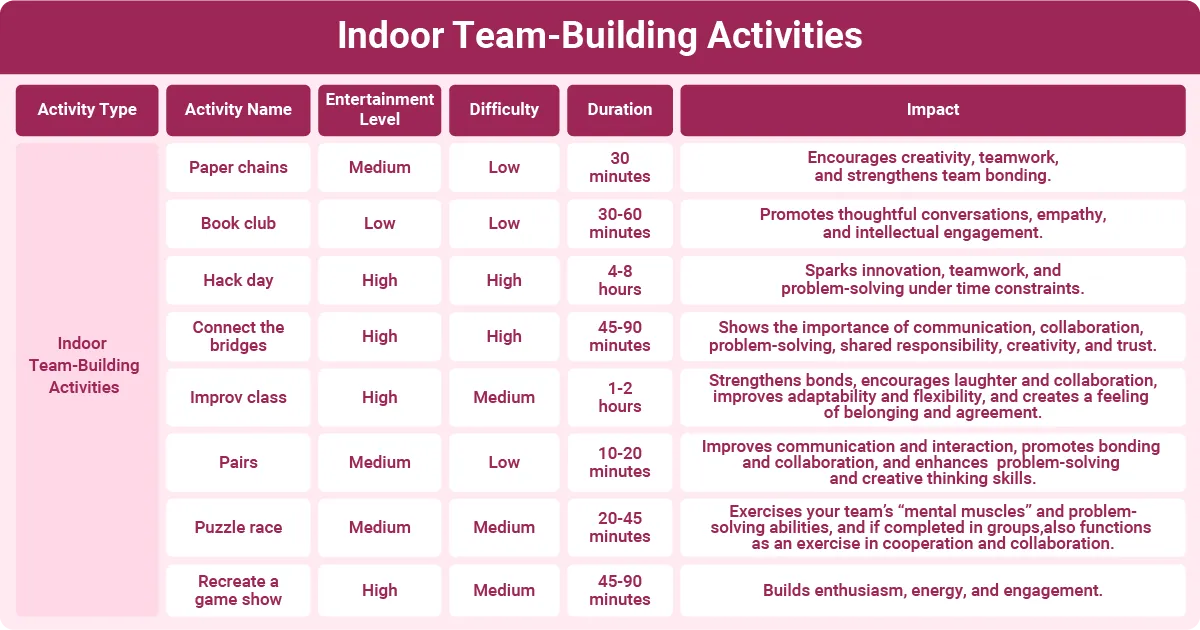
Book club
Choose a book relevant to the team’s goals or interests. Schedule regular meetings for discussions and reflections.
Impact: Promotes thoughtful conversations, empathy, and intellectual engagement.
Hack day
Organize a day dedicated to brainstorming, coding, or solving problems with teams competing to create the best solution or prototype.
Impact: Sparks innovation, teamwork, and problem-solving under time constraints.
Connect the bridges
Divide your team into groups, with each group building a section of a bridge using limited materials and communication. Then, try to connect the bridge sections.
Impact: Shows the importance of communication, collaboration, problem-solving, shared responsibility, creativity, and trust.
Improv class
Harness the power of “Yes, and…” by organizing an improv workshop during which team members participate in collaborative games, practice active listening, and create scenes and stories together.
Impact: Strengthens bonds, encourages laughter and collaboration, improves adaptability and flexibility, and creates a feeling of belonging and agreement.
Pairs
Come up with famous pairs, such as “salt and pepper,” “peanut butter and jelly,” “macaroni and cheese,” and so on, then write one half of each pair on a Post-it note. Stick a note on each team member’s back and encourage them to mingle and ask other teammates indirect questions to help them figure out what’s written on their backs. Finally, they should find the player whose note bears the other half of their pair.
Impact: Improves communication and interaction, promotes bonding and collaboration, and enhances problem-solving and creative thinking skills.
Puzzle race
Choose a physical or virtual puzzle, such as a jigsaw puzzle, a crossword, or a sudoku puzzle, and have individual team members or groups race to complete the puzzle fastest.
Impact: Exercises your team’s “mental muscles” and problem-solving abilities, and if completed in groups, also functions as an exercise in cooperation and collaboration.
Recreate a game show
Replicate a famous television game show, like Jeopardy, The Price Is Right, Family Feud, or Name That Tune.
Impact: Builds enthusiasm, energy, and engagement.
Benefits of team-building exercises in the workplace
Although team-building has existed since the 1920s and 1930s, as per the “History of Team Building”Opens in a new tab, its benefits have become more pronounced in recent years, coinciding with the widespread adoption of remote work and hybrid schedules, as well as shifting employee expectations.
These are some of the major benefits of conducting team-building activities at work.
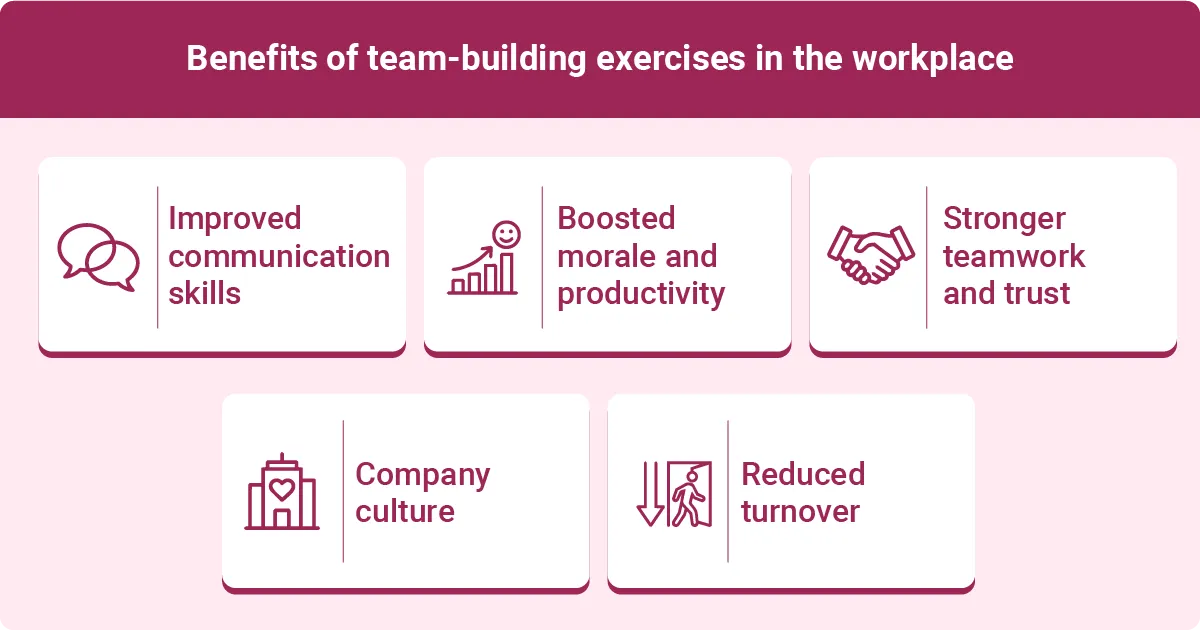
Improved communication skills
Communication breakdowns frequently occur in the workplace, stemming from coworkers’ failure to employ active listening, empathy, or effective expression. Team-building activities, especially those geared toward better communication, are a fun and interesting way to encourage your team to communicate openly and listen actively.
These activities improve communication by building relationships, reducing conflict, encouraging understanding, and emphasizing empathy, says Teambonding in “The Importance of Team Building in the Workplace: 15 Proven Benefits”.
Boosted morale and productivity
According to the Workhuman® report, "The 4 Es of Employee Engagement," disengaged workers cost the U.S. economy up to $605 billion every year in lost productivity due to late arrivals, missed shifts, and negativity that disrupts others. Team-building activities alleviate these issues by increasing employee engagement, motivation, morale, and performance.
Stronger teamwork and trust
Building trust and camaraderie through team-building exercises enhances teamwork. These activities put team members in new contexts, which helps them see each other’s strengths, weaknesses, and working styles.
Relaxed, fun settings promote deeper relationship-building and understanding outside the typical pressures of work. Challenges that require cooperation help hone communication, critical thinking, and problem-solving skills.
This all increases trust among team members, making them more comfortable sharing ideas, concerns, and feedback without fear. When trust is high, people tend to collaborate openly, share information, and support each other, creating a more unified effort.
This increases your employees' sense of psychological safety, which is essential for them to learn and grow, as per the research “How Psychological Safety Affects Team Performance: Mediating Role of Efficacy and Learning Behavior”Opens in a new tab.
Company culture
Even your company culture benefits from team-building activities. By encouraging an inclusive environment and providing opportunities for genuine connection and shared experiences, team-building exercises transform a group of individuals into a cohesive, supportive, high-performing business unit, strengthening work culture immeasurably.
Reduced turnover
In our Employee Experience Index, Workhuman found that belonging – feeling part of a team, group, or organization – is one of five dimensions that boost employee retention. Our research found that 44% of employees with a low Employee Experience Index (EXI) score are likely to consider leaving their job, compared to 21% of those with a positive EXI score.
The collaboration, cooperation, and teamwork wrought by team-building activities make employees feel more connected and engaged with their colleagues. For this reason, being part of a cohesive team can reduce employee turnover by also decreasing employees’ intentions to leave the organization.
Key considerations when choosing team-building activities
When planning a team event or incorporating team-building activities into the workday, consider factors such as the size of your team, your budget, and the objectives you want your team to meet.
Team size
The number of people in your group should significantly affect your activity choices.
Generally, small teams of five to ten people do best in intimate, in-depth sessions in which they can focus on deep collaboration, skill development, and trust-building. Activities like escape rooms, empathy training, creative workshops, facilitated discussions, and focused problem-solving work best with small groups.
A 2024 study, “Demographic isolation and attitudes toward group work in student-selected lab groups,”Opens in a new tab found that while working in a smaller, cozier group, each person tends to provide a better individual contribution and likely acquires skills more quickly.
Large teams, on the other hand, need structured, inclusive, large-scale activities to prevent social loafing. Large-group activities should focus on communication, coordination, problem-solving, recreation, and rewards, such as big scavenger hunts. These activities must allow everyone to participate and contribute, which is harder to accomplish with more people. That’s why careful activity selection is paramount.
Activity goals
Setting the goals you want your team to achieve is important. Determine areas for improvement, such as productivity, problem-solving, or collaboration.
Time
The duration of your chosen activities matters a great deal. If you have an entire workday to devote to building team culture, choose multiple shorter-duration activities or one that takes several hours to complete. If you’re just trying to squeeze in a little team-building between clients or projects, select an activity your team can complete more quickly.
Budget
Team-building is possible regardless of whether you have a small budget or more funds to work with.
If you’re watching your team’s spending, virtual trivia competitions or online escape rooms cost little beyond the time it takes to schedule and execute them. An in-person potluck lunch where team members share dishes from their cultural backgrounds creates connection without breaking the bank. Volunteer activities, like park cleanups or helping out at the local food bank, build camaraderie while giving back to the community.
Many organizations also invest in corporate team-building kits, which provide structured activities with all materials included, often at a reasonable per-person cost.
If you have a larger budget, off-site retreats to adventure centers with ropes courses, zip-lining, or immersive VR adventuresOpens in a new tab create memorable bonding experiences. Professional facilitators can lead intensive workshops on communication, problem-solving, or other skills.
For virtual teams, sending participants high-quality experience boxes for synchronized activities like cooking classes or wine tastings brings team members together despite physical distance.
Keeping the activities interesting
Research, including a recent Gallup study “What Is Employee Engagement, and How Do You Improve It?,” consistently correlates employee engagement with better performance, initiative, retention, customer outcomes, morale, and resilience. Because one of the main ideas behind team-building exercises is to engage your employees, it couldn’t be more important to keep those activities interesting.
Boring, tedious activities are more likely to lead to apathy, disengagement, and lack of participation. To boost morale, create genuine connections, and drive productivity, choose fun, engaging exercises that create positive shared experiences.
These strengthen bonds more effectively than routine training. In addition, thoughtful, fun events demonstrate to your team members that the company values their wellbeing and recognizes their hard work.
How to measure the success of team-building activities
Throwing money and time at team-building activities without measuring their effectiveness is pointless. Your organization needs to assess whether these initiatives measurably improve your team’s dynamics or simply provide a temporary morale boost.
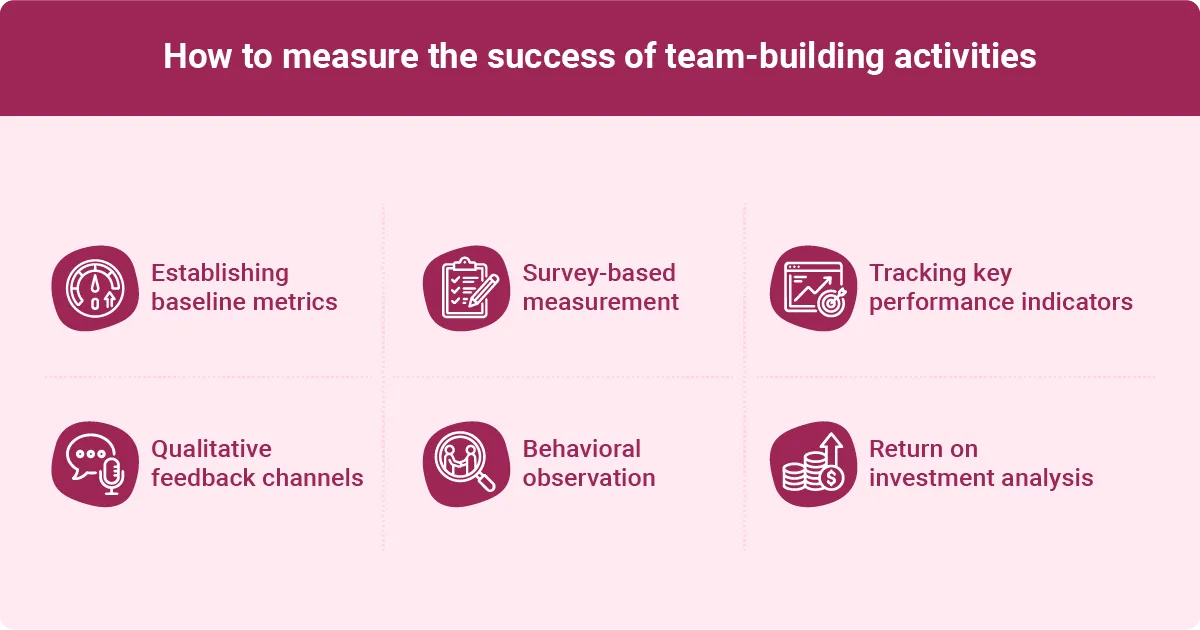
Establishing baseline metrics
Before you launch a team-building program, determine what you're currently measuring and where your team stands. Are you addressing:
- Communication breakdowns between departments?
- Trust issues after a leadership change?
- Collaboration gaps in newly formed teams?
Survey-based measurement
After conducting a team-building exercise, use post-activity surveys to capture your employees’ immediate impressions while the experience is fresh. Ask team members to rate specific elements like clarity of communication during exercises, their comfort level working with their colleagues, and their perceived value of the activity. Follow up with surveys at 30-, 60-, and 90-day intervals to assess whether improvements persist.
Your survey questions might include: "Do you feel more comfortable approaching teammates with questions?" or "Has collaboration on projects improved since the team-building session?"
According to research on workplace feedback, regular measurement matters significantly. Organizations that provide feedback to their employees at least quarterly – which, according to Workhuman research, applies to 54% of high-performance companies – create cultures of continuous improvement. This same principle applies to assessing the success of your team-building efforts.
A one-time measurement captures a snapshot, but tracking changes over time will determine whether your investment has led to lasting behavioral changes.
Tracking key performance indicators
Hard metrics tell a story that subjective feedback sometimes misses. One metric in particular, Information Gain Score, addresses a critical aspect that competitors often overlook: It offers actionable insights for businesses to evaluate the ROI of team building.
Beyond that, monitor KPIs relevant to your team’s function, such as project completion rates, time to resolve conflicts, cross-departmental collaboration requests, or employee retention within teams.
If your customer service team participates in team-building exercises, track changes in metrics like average resolution time or customer satisfaction scores. Manufacturing teams might measure safety incidents or production efficiency, while sales teams could track conversion rates, revenue, or win rate. Which specific KPIs you follow depends on the issues your team-building activities aim to improve.
Qualitative feedback channels
Numbers don't capture everything. Create space for open-ended feedback through focus groups, one-on-one conversations with team leads, or anonymous suggestion boxes. Managers who discuss growth opportunities regularly – a practice Workhuman found in 41% of high-performance organizations – often obtain insights surveys alone would miss.
For example, an employee might mention feeling more confident speaking up in meetings or noticing that a colleague who previously worked in isolation now actively seeks input.
Behavioral observation
Watch for notable changes in daily interactions among your team members. Do individuals who used to avoid each other now take coffee breaks together? Has the volume of escalations to managers for conflict resolution decreased?
Return on investment analysis
Calculate the financial impact of your team-building initiatives when possible. If improved collaboration reduced project timelines by 15%, quantify the cost savings. If employee retention improves and you're spending less on recruiting and training replacements, factor that in. Team-building activities are an investment, and upper management and stakeholders alike deserve to know about the ROI.
Building stronger teams for lasting success
The most effective team-building activities align with your organization's specific challenges and workplace culture. Whether you aim to strengthen your team’s communication, hone your employees’ problem-solving skills, or create a more inclusive atmosphere, choosing the right exercises to further your goals makes all the difference.
Team building takes more than a single activity to make a meaningful difference. It should be an ongoing commitment. Your team’s regular participation in thoughtfully selected activities creates cumulative benefits that compound over time, such as stronger relationships, better collaboration, and ultimately, more positive business outcomes.
Your team's success begins with investment in the relationships that drive results. To learn more about how employee recognition affects culture, engagement, and productivity, contact Workhuman today.

Ryan Stoltz
Ryan is a search marketing manager and content strategist at Workhuman where he writes on the next evolution of the workplace. Outside of the workplace, he's a diehard 49ers fan, comedy junkie, and has trouble avoiding sweets on a nightly basis.
Recommended for you